
Her på Blåvand's blog bringes korte nyheder i dagbogsformat om livet og hændelser på fuglestationen.
-
FORSIDE

- Blog
Up and down and up and down
lørdag 10. oktober 2026
Ringing: Another day of ringing, trying to reach 5 hours with high gusts and sudden showers, but we persisted and actually got some birds too!
The morning started with some super nice thrushes!
*loading*
Today's numbers:
*loading*
Observation: Today, like yesterday, had looming rainfalls and moderate winds on the forecast - something I did not want to stand in for three hours yet again… So we (Henrik Læssøe, Kristoffer Hansen, Maria Rasmussen, and I) decided to head for the Sabines bunker; a place where we could seek shelter from the rain and winds.
The morning started out great with me spotting a Sooty Shearwater (Ardenna grisea) at medium distance at 07.28 in the morning. Unfortunately this was way before standard migratory counting started today, so of course, we had to spot another one within standard. This happened around 08.45, when Kristoffer spotted one very close (only a couple of hundred meters out). Henrik had just left his post to get some coverage on his phone (the bunker blocks all cellular service) in case someone had spotted something rare somewhere else. Luckily Henrik made it back to his chair, and we all had great views of the shearwater.
The only other real highlight of the day were the migrating Little Gulls (Hydrocoloeus minutus), of which we saw 6, and the beginnings of the alcid migration. As for the alcids we saw 3 Common Murres (Uria aalge), 20 Razorbills (Alca torda), and 6 which were unidentifiable due to the range at which they flew by.
As for the usual birds, i.e. Northern Gannets (Morus bassanus), Common Scoters (Melanitta nigra), and Red-throated Loons (Gavia stelatta), the numbers were pretty average. We had 18 Northern Gannets, 722 Common Scoters, and 199 Red-throated Loons fly by.
Overall a pretty decent day conditions considered. Especially the shearwaters were highlights for me, as I have only ever seen Sooty Shearwaters at great distances!
At the station: Strummer Edwards, Anton Ræbild Jensen, Johan Them Steffensen
Many cool species!
fredag 9. oktober 2026
Ringing: What a special day of ringing! Not a crazy amount of birds, but we also didn't reach the standard 5 hours, due to the rain. We ended up with 43 birds of 13 different species - and what cool species!
One of the first rounds I was walking through the station garden, I suddenly came upon four Bramblings (Kvækerfinke) in one net! I immediately notified Strummer and Johan, who quickly came and joined me, so we could appreciate all four wonderful individuals together - all male, three certainly young, and one potential adult.
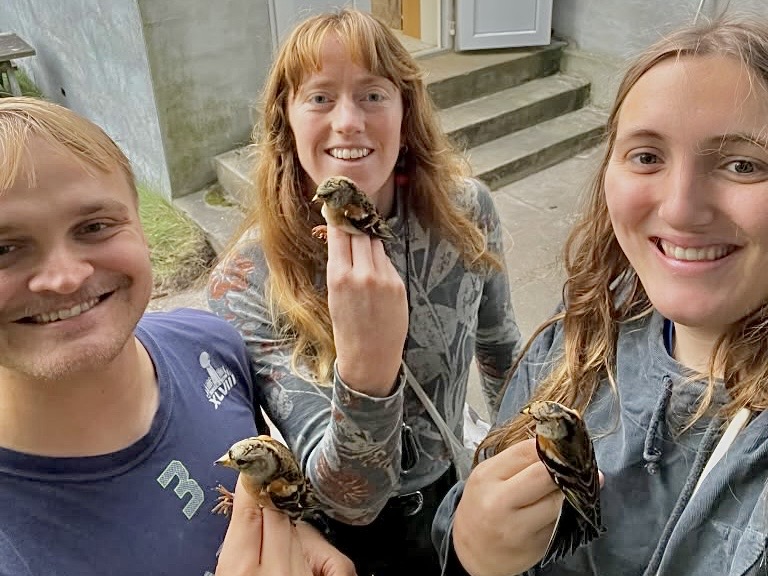 The ringing team with three young male Bramblings of today. Picture by Strummer Edwards.
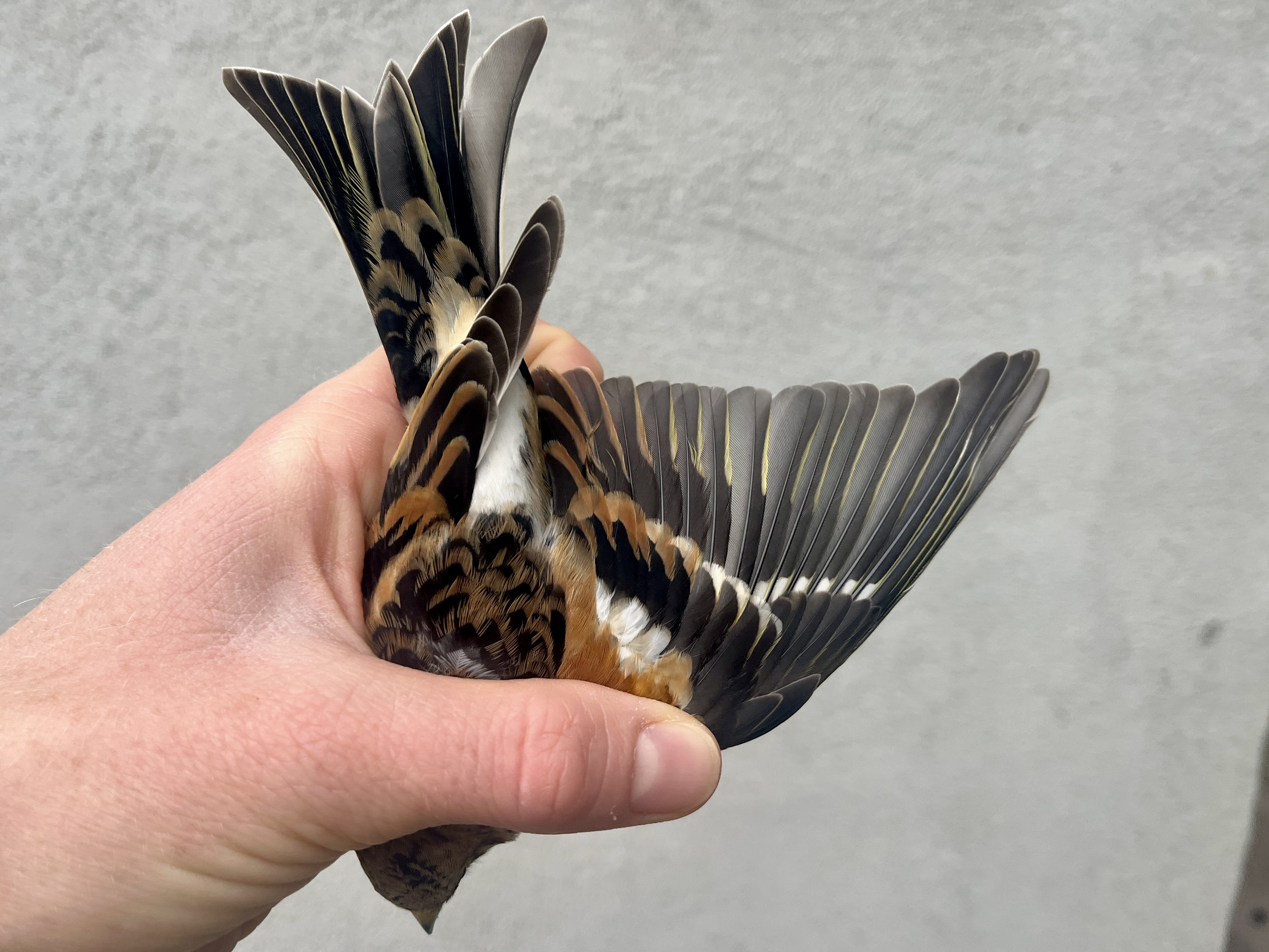 One of the young male Bramblings. Aged on the clear moult limit, in the feather group called the greater coverts in the middle of the wing, contrasting between the new darker feathers and the paler young feathers. Sexed on the pure orange lesser coverts, the feather group half covered by my thumb. Picture by Mathilde Sif Eiby.
What a great start to the day! I even caught a fifth Brambling later in the day together with three of my favourite bird, the Yellowhammer (Gulspurv). One female on it's own, and two males in the round after - one certain youngster, and one potential adult.
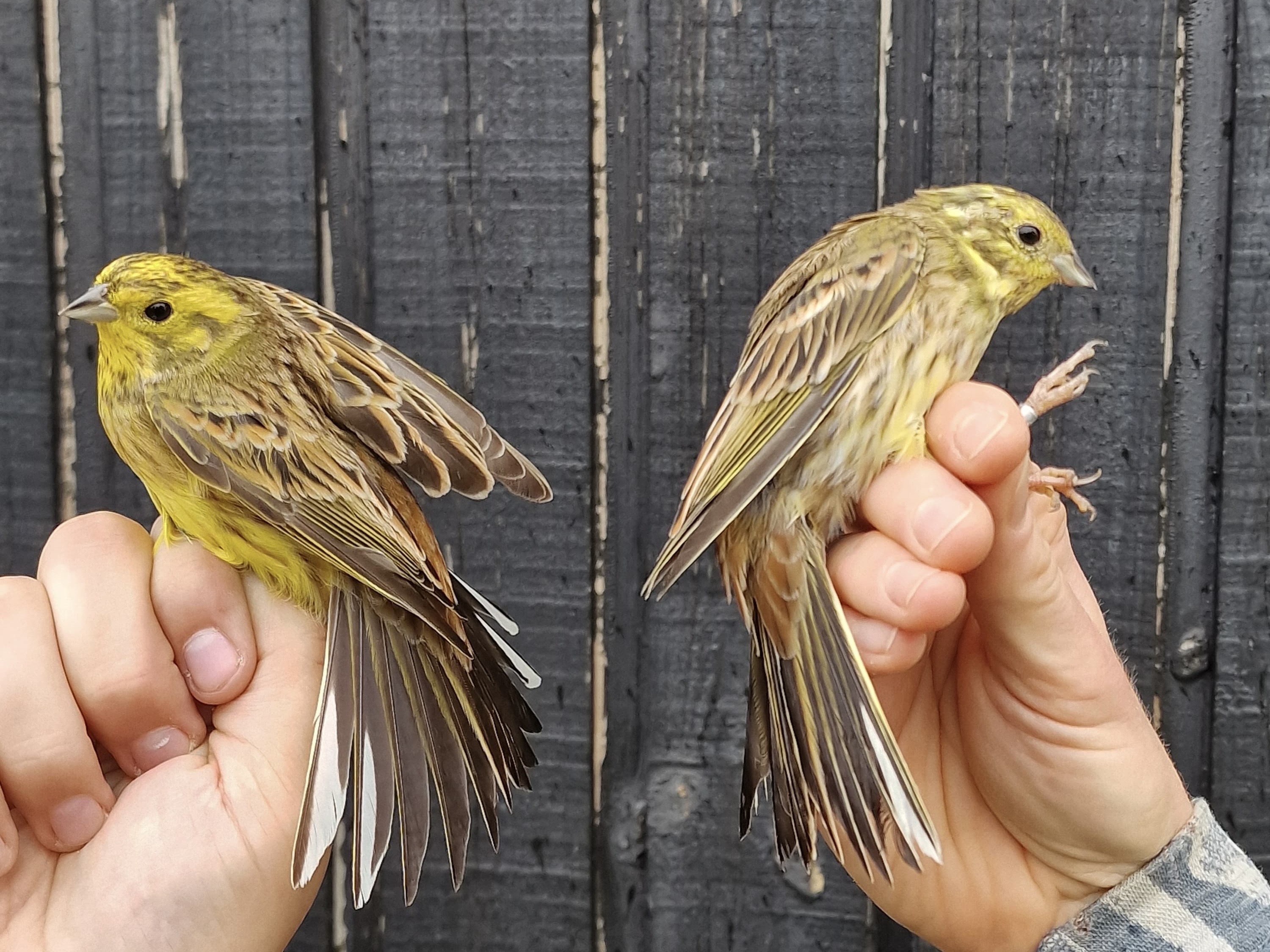
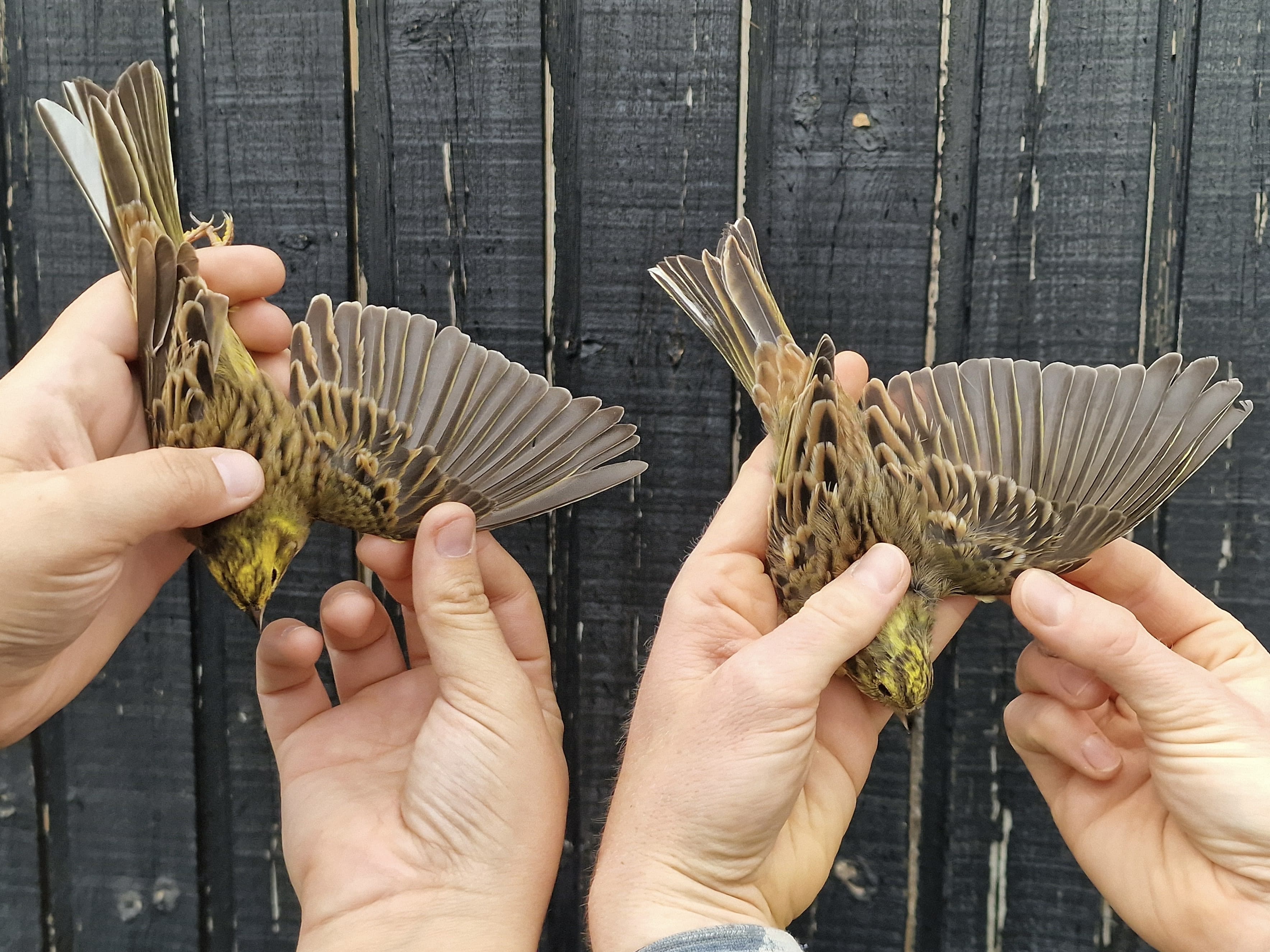 The two male Yellowhammers from today. The one on the right is the young one, significantly paler, and with more pointed tailfeathers. Pictures by Anton Ræbild Jensen.
I also came across the third Yellow-browed Warbler (Hvidbrynet Løvsanger) of the season, that I immediately called Johan for, as it was time for him to ring one. His sister by chance came to visit the station at that exact moment, so the first ever species she's seen being ringed was that one!
When Henrik and Anton came back from obs, they told me they'd seen a potential subspecies of the Lesser Whitethroat (Gærdesanger / Curruca curruca) called Blythi (Curruca Curruca Blythi), and next round Strummer calls me to tell me they caught it up at the lighthouse! There's only five other confirmed records ever of this subspecies in Denmark, one of which was in Blåvand. We took pictures and sampled some DNA, so we'll have the definite answer at some point.
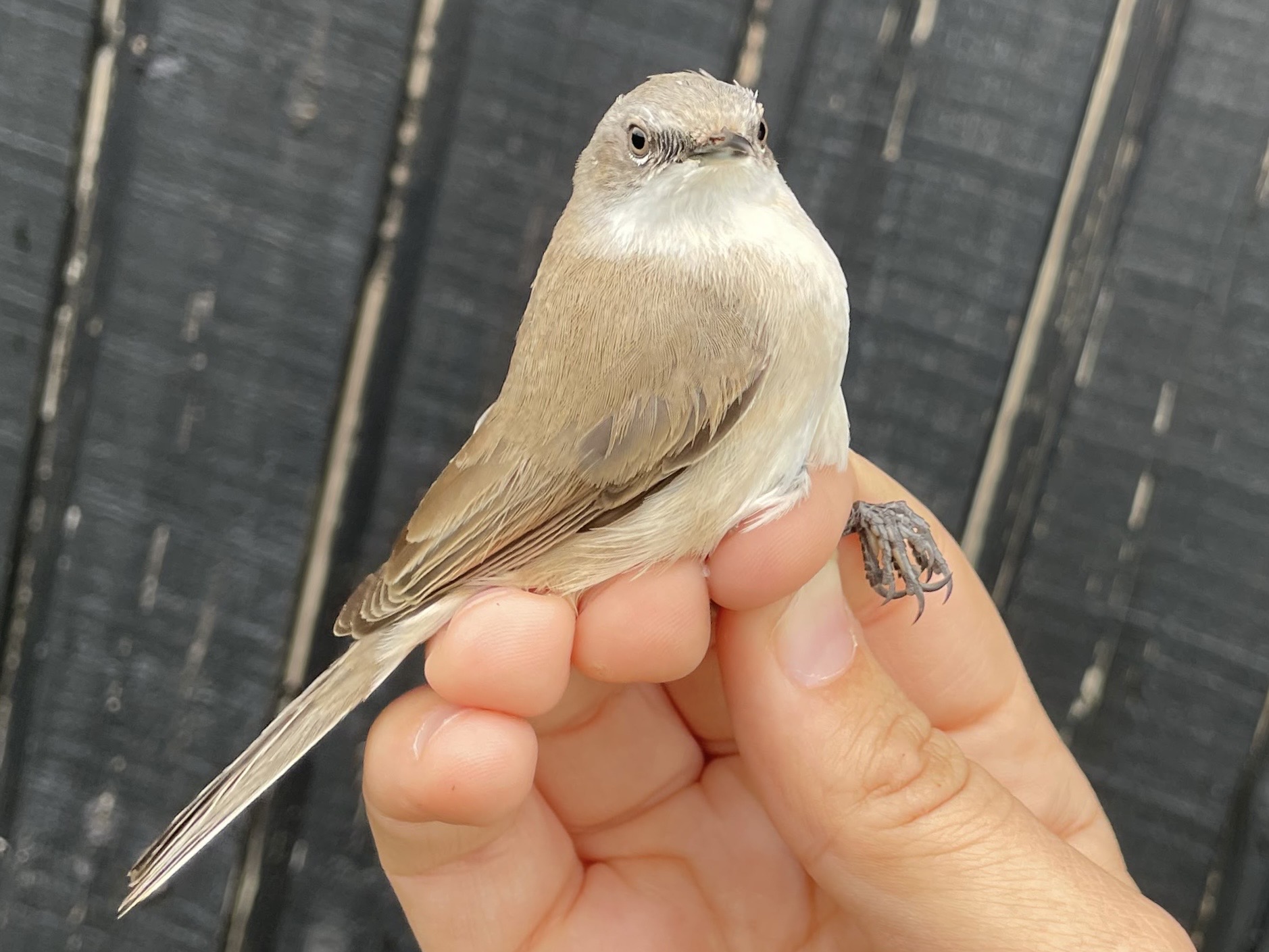 Today's potential Curruca Curruca Blythi, with a more sandy color. Picture by Strummer Edwards.
Today's numbers:
*loading*
Observation: Today was supposed to be kind of a mixed bag with rains coming and going and milder winds from the northwest, the west and the southwest - safe to say, I (Anton) expected a slow day with maybe decent numbers of passerines.
Aaaaand, that is what we got. The Chaffinches/Bramblings (Fringilla coelebs/F. montifringilla) were moving as usual with about 200 flying by. We also saw over 250 Starlings (Sturnus vulgaris) and even 11 Rock Pipits (Anthus petrosus). Pretty okay, but not mindblowing.
The big highlights were one Hen Harrier (Circus Cyaneus), one Short-eared Owl (Asio flammeus) and a pretty good 1019 Meadow Pipits (Anthus pratensis)! Of course, we also saw the Eastern Lesser Whitethroat at obs, but only shortly before it vanished up towards the lighthouse.
At the station: Strummer Edwards, Mathilde Sif Eiby, Anton Ræbild Jensen, Johan Them Steffensen
Still no Storm-petrels for me...
torsdag 8. oktober 2026
Ringing: Cancelled due to strong winds and rain.
Observation: Today Johan and I (Anton) decided to go all in on the seawatch. With quite strong winds from the north and northwest, we knew that that would be our best bet for seeing anything interesting (especially Storm-petrels) at obs today.
The morning started with Johan finding a single Skua - unfortunately, it was raining quite a bit, and the sun wasn’t even up, so visibility was too low for us to be able to identify what species of Skua it was. No worries, though; we ground on, hoping another Skua, or maybe even a Shearwater or Storm-petrel, might fly by.
During the day, there were few birds because of the strong winds. We did, however, see over 700 Common Scoters (Melanitta nigra), 76 Northern Gannets (Morus bassanus) and 48 Red-throated Loons (Gavia stellata). We were also lucky enough to see a couple of Merlins (Falco columbarius) and a few Hen Harriers (Circus cyaneus).
Near the very end of the obs, Johan managed to spot the day's second proper seabird - this one a Sooty Shearwater (Ardenna grisea). Another pretty decent bird, but not really what we had dreamed about when looking at the weather report yesterday.
As obs ended, Johan decided to go straight home, while Mathilde and I decided to stay a little while longer. This led to both a Horned Lark (Eremophila alpestris) and a Black-throated Loon (Gavia arctica), and on our way back to the station, a probable Little Bunting (Emberiza pusilla) flew right over us (I damn myself for not using a microphone today!).
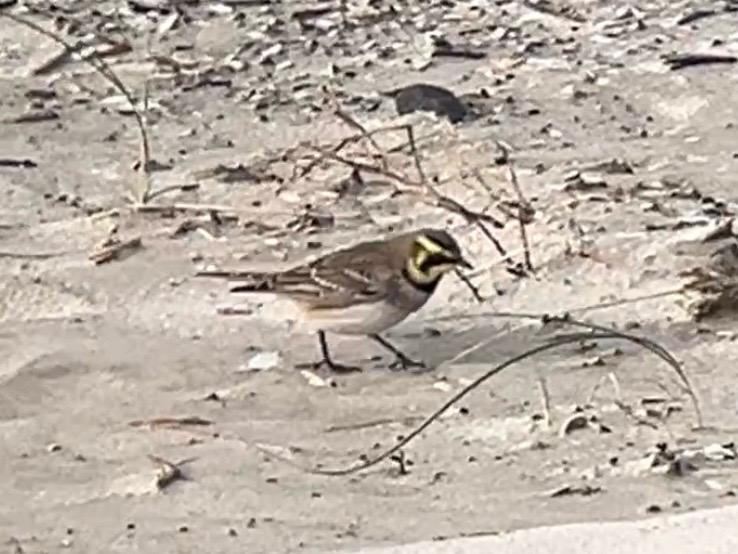
Phone-shot of the Horned Lark. Credit Mathilde Sif Eiby
Johan, Mathilde, and I decided to end our day with a final evening seawatch, hopeful that the wind had finally blown a Storm-petrel close to shore. Our dreams of Storm-petrels were, however, shattered, but I did manage to find two Sooty Shearwaters more. So overall it was a good way to end yet another day in Blåvand!
Other things: All of our recent guests have left the station today/yesterday, and with Storm still gone, it feels quite empty at the station. We will, however get a good amount of guests over the coming weekend, which I am looking forward to.
At the station: Strummer Edwards, Mathilde Sif Eiby, Anton Ræbild Jensen, Johan Them Steffensen
SO MANY ROBINS
onsdag 7. oktober 2026
Ringing: A pretty hectic morning with crazy numbers of Robins (Rødhals)! 123 Robins out of 185 birds in total, and only 8 other species. But among those we still had two new species of the season! One of them was one of those we see regularly on observation, but rarely in the nets - the Brambling (Kvækerfinke). And even a beautiful male! Sadly we were too busy to admire it all together, so we'll need another one for the whole team to appreciate one day.
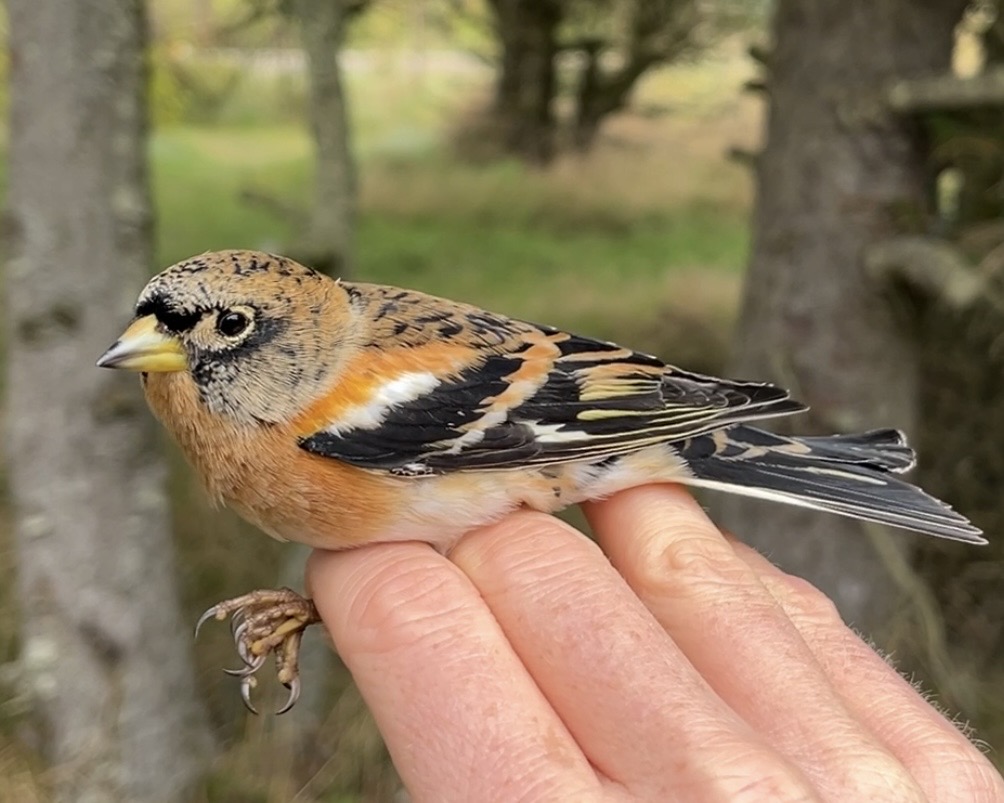 Have you ever seen such a handsome Brambling? Picture by Mathilde Sif Eiby.
The other new species was one we've been expecting - the Goldcrest (Fuglekonge). Super nice to have it back - more and more are probably gonna start showing up. We also recaught the Yellow-browed Warbler (Hvidbrynet Løvsanger) from yesterday - listened to it calling all morning, so we weren't surprised. It has such a cute and distinct call, I recommend you learn it!
Today's numbers:
*loading*
Observation: Today we were hoping for great numbers. If you have been reading the blog the last couple of days, you might know that the last few sessions haven't brought as big numbers of birds as hoped for. The wind hasn’t been the best, and the last couple of days have been mediocre quantity-vise
That is why today was supposed to be a big day! The wind switched to the east (which can be very dangerous) and I expected either great numbers of passerines and/or (ESPECIALLY) thrushes. And honestly… I can’t say that I was disappointed per se, but my hopeful expectations were not met.
The finches were moving, with 4250 Chaffinches/Brambling (Fringilla coelebs/F. montifringilla) flying by - with more Bramblings than usual - and the thrushes have finally started migrating with 67 Songthrushes (Turdus philomelos), 95 Redwings (Turdus iliacus), 7 Mistle Thrushes (Turdus viscivorus), and a single Fieldfare (Turdus pilaris) flying by. While these numbers aren’t bad (especially compared to the last couple of days) I had hoped for more. In other parts of the country there have been great numbers of migrating thrushes, but for some they refused to fly by me...
And if today wasn’t a numbers game, you might think that the hits would be there. The big highlights of today were two Horned Grebes (Podiceps auritus) that Mikkel spotted flying past us, and one male Hen Harrier (Circus cyaneus) foraging in the area. Again, these aren’t bad hits, but I would have hoped for more.
So all in all a day characterized by mediocrity and slight disappointment.
At the station: Strummer Edwards, Mathilde Sif Eiby, Anton Ræbild Jensen, Johan Them Steffensen, Alex, Bello, Britta
The return of the GOAT
tirsdag 6. oktober 2026
Ringing:
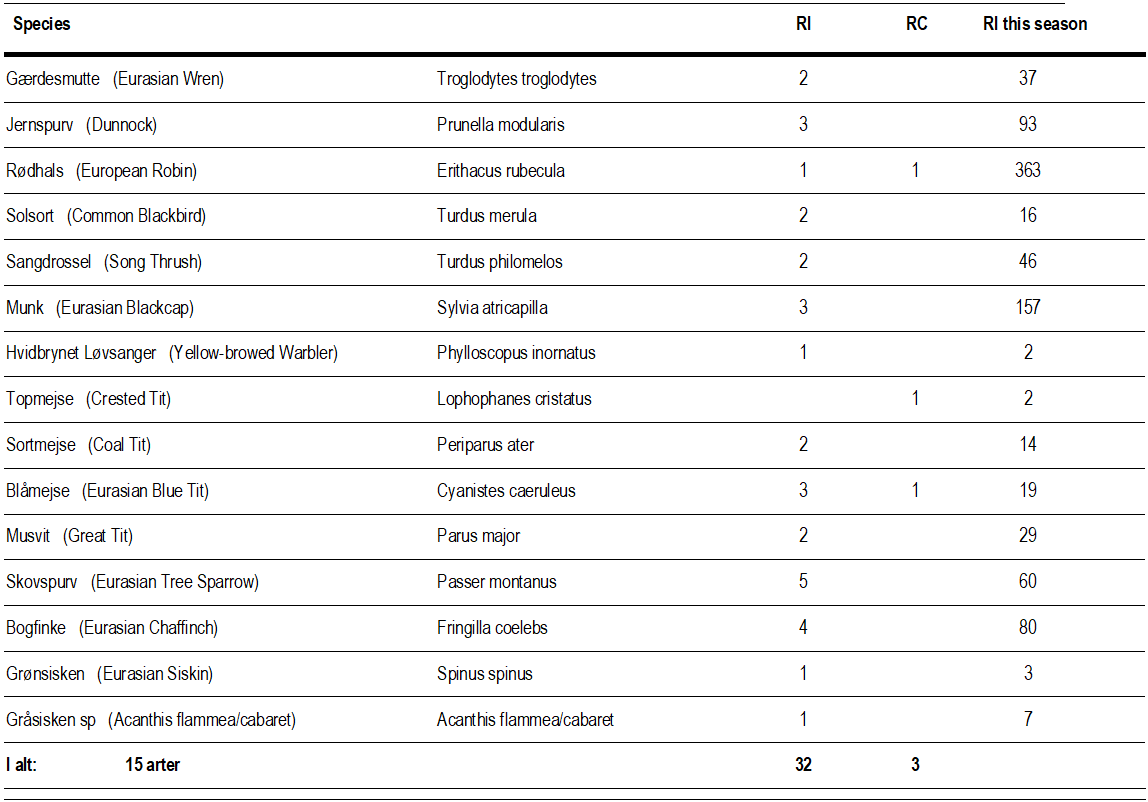
Today was another chill day of ringing with 35 birds, but of nothing less than 15 different species! Other than the regular ones we had another beautiful Yellow-browed Warbler (Hvidbrynet Løvsanger), which I then got on my own ringing list - a list I just keep for fun, since I already handled the one Strummer ringed several times as a recapture. Another one checking out the garden - many days we hear their distinct call at the station.
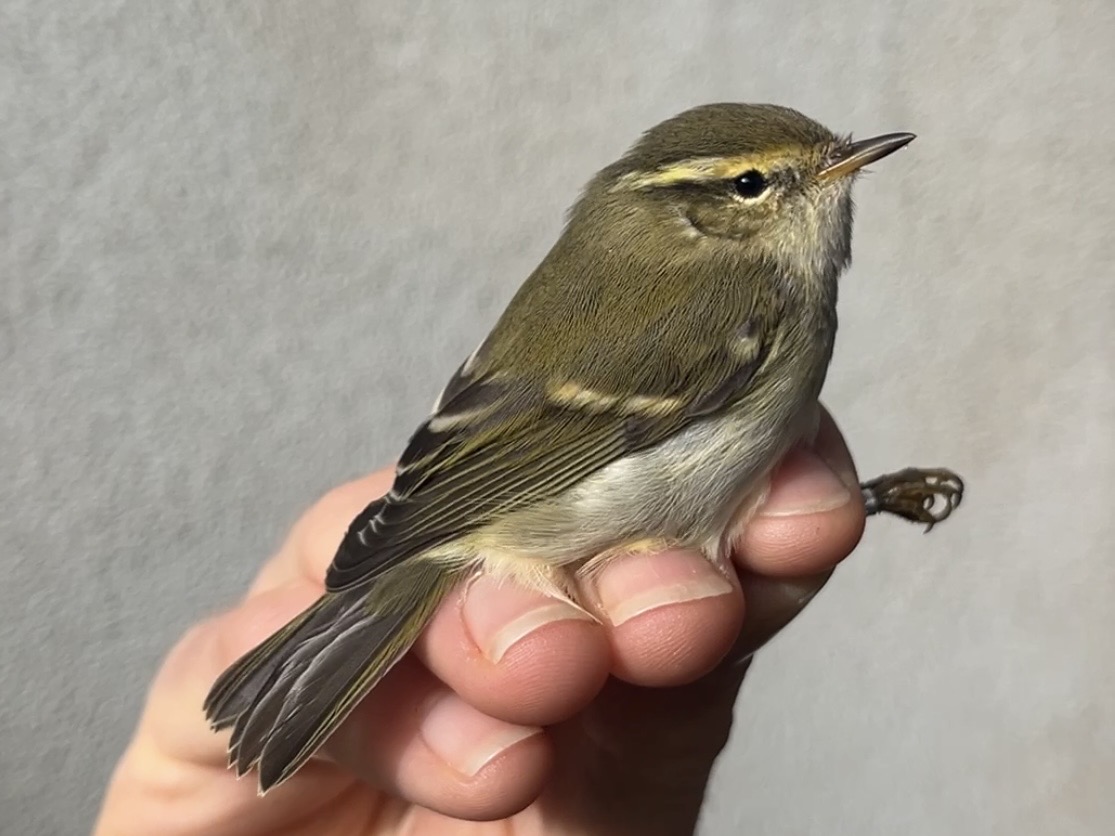 My own Yellow-browed Warbler! Such a stunner! Picture by Mathilde Sif Eiby
Out of many honorable mentions (all birds are of course amazing) we also had Redpoll (Gråsisken), Crested Tit (Topmejse), Sortmejse (Coal Tit) and a lovely Siskin (Grønsisken).
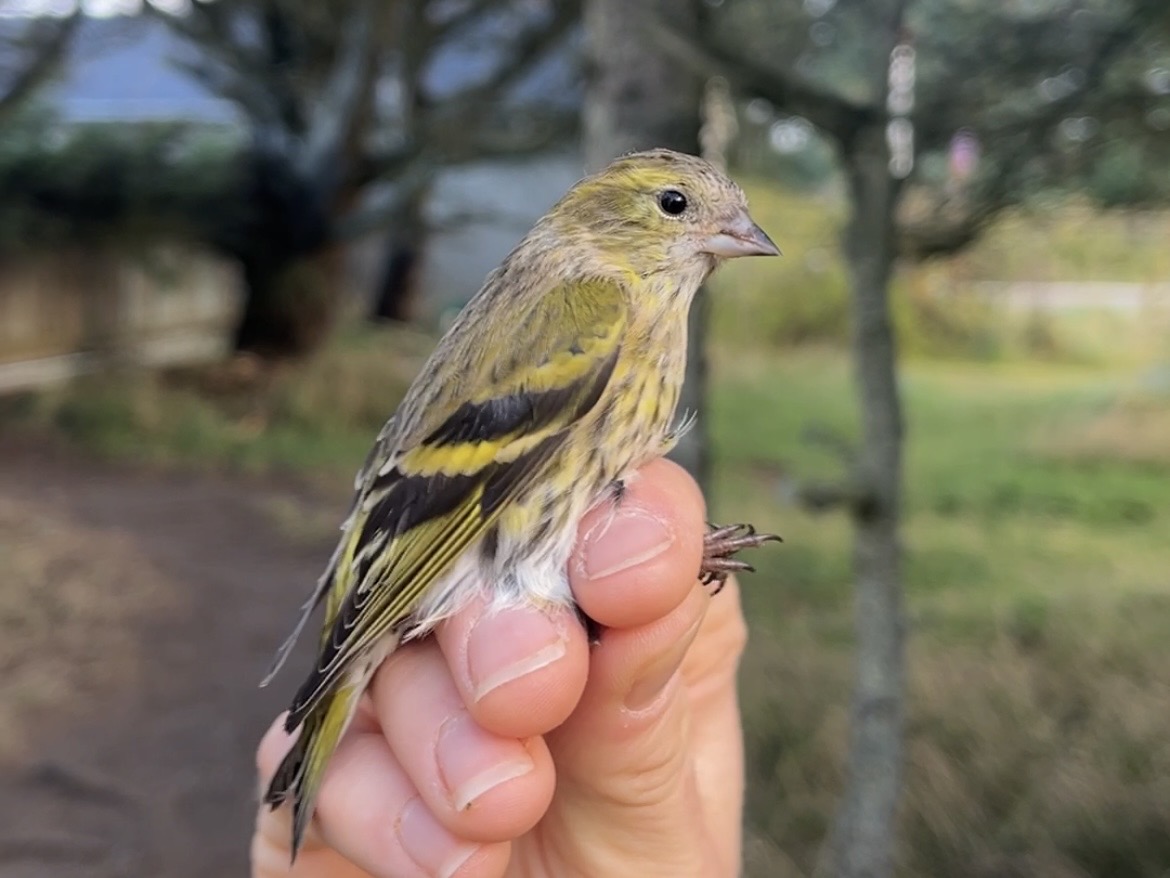 A young female Siskin, aged by the duller outer greater coverts, and sexed by the lower extend of greenish yellow and lack of dark crest feathers. Picture by Mathilde Sif Eiby.
Last cool bird of the day was this Great Tit (Musvit), with a nice moult limit - see if you can spot it!
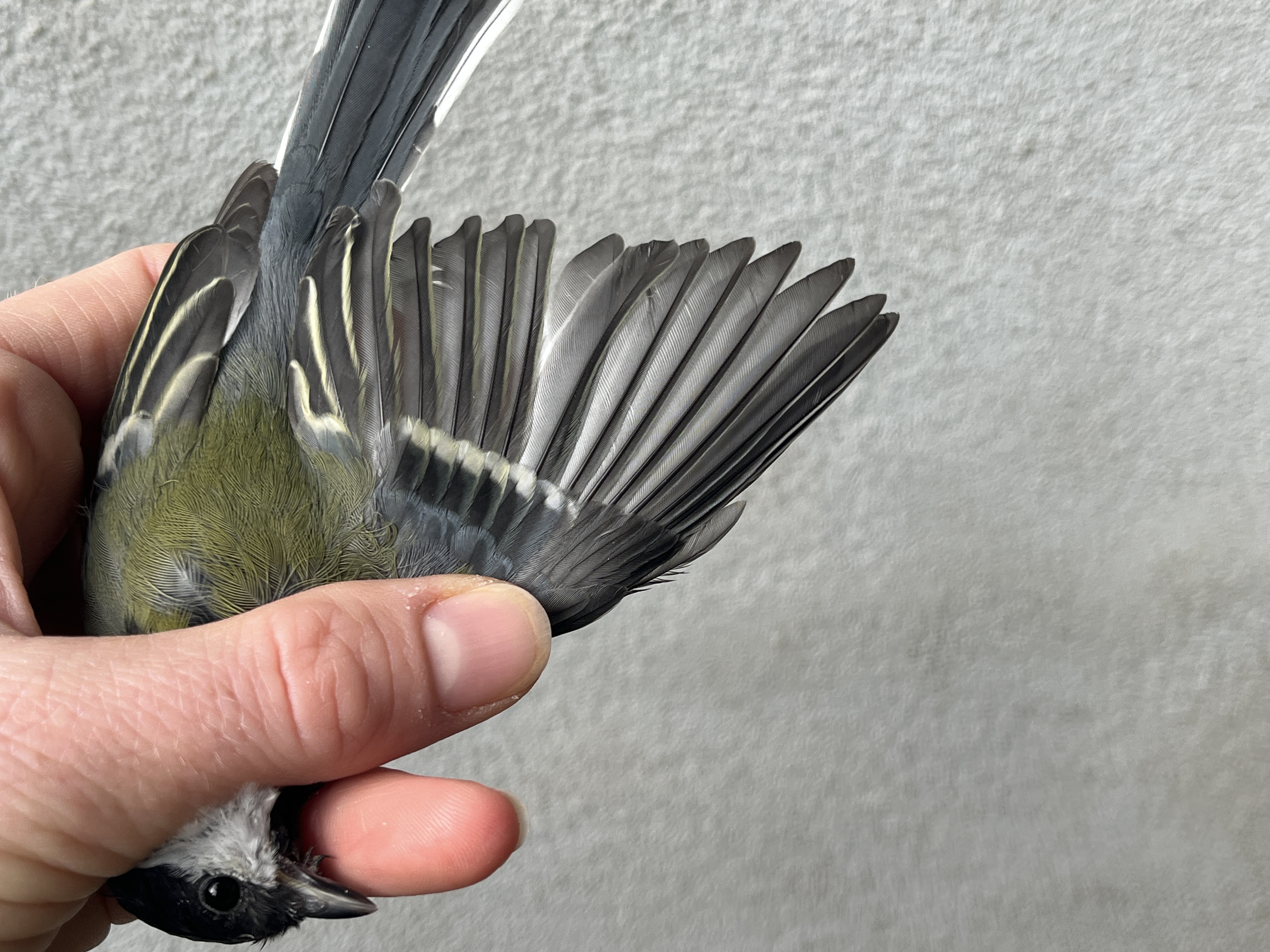 A young Great Tit. Ageing hint: look in the greater coverts just above the tip of my thumb. Picture by Mathilde Sif Eiby.
Today's numbers:
Observation:
Northwesterlies. Again. You know what that means: Awesome day for birds in Blåvand! I know it makes no sense but today turned out quite well.
The standardized observation this morning didn't have too many birds. We barely scratched 100 Meadow pipits (Anthus pratensus) and the same with Common Scoters (Melanitta nigra).
The highlight of the morning was myself spotting a shearwater that didn't look like all the others I've been seeing all season. I quickly mumbled to Anton: "Shearwater out there now... Not sooty. It's a Manx!". Anton quickly agreed and we got it reported to the birders around. A lifer for myself and to be self-found was a dream. We've only had one other this season on the 2nd of August seen by the spanish observation team, so all of us on the beach were quite pleased. Additionally this bird came maybe only 50m away from the shore, so the looks were quite a bit better than the majority of shearwater observations.
With the low numbers we decided to evacuate after obs anyway, which also turned out to be quite a good decision. Only 10 minutes after arriving back at the station, the seasons first Northern Nutcracker (Nucifraga caryocatactes) came flying towards the station. I myself ran from my slumber on the couch and saw it land in a tree in our garden, and show off for 10 minutes in the top of our trees. This individual was the subspecies "Thickbilled" (ssp. caryocatactes). These are to my understanding the most common guests in Denmark, but this last week the biggest invasion has been of the siberian "Slender-billed" subspecies. So this made our obs a bit more special than all the other (This is not just me coping for it not going in our nets).
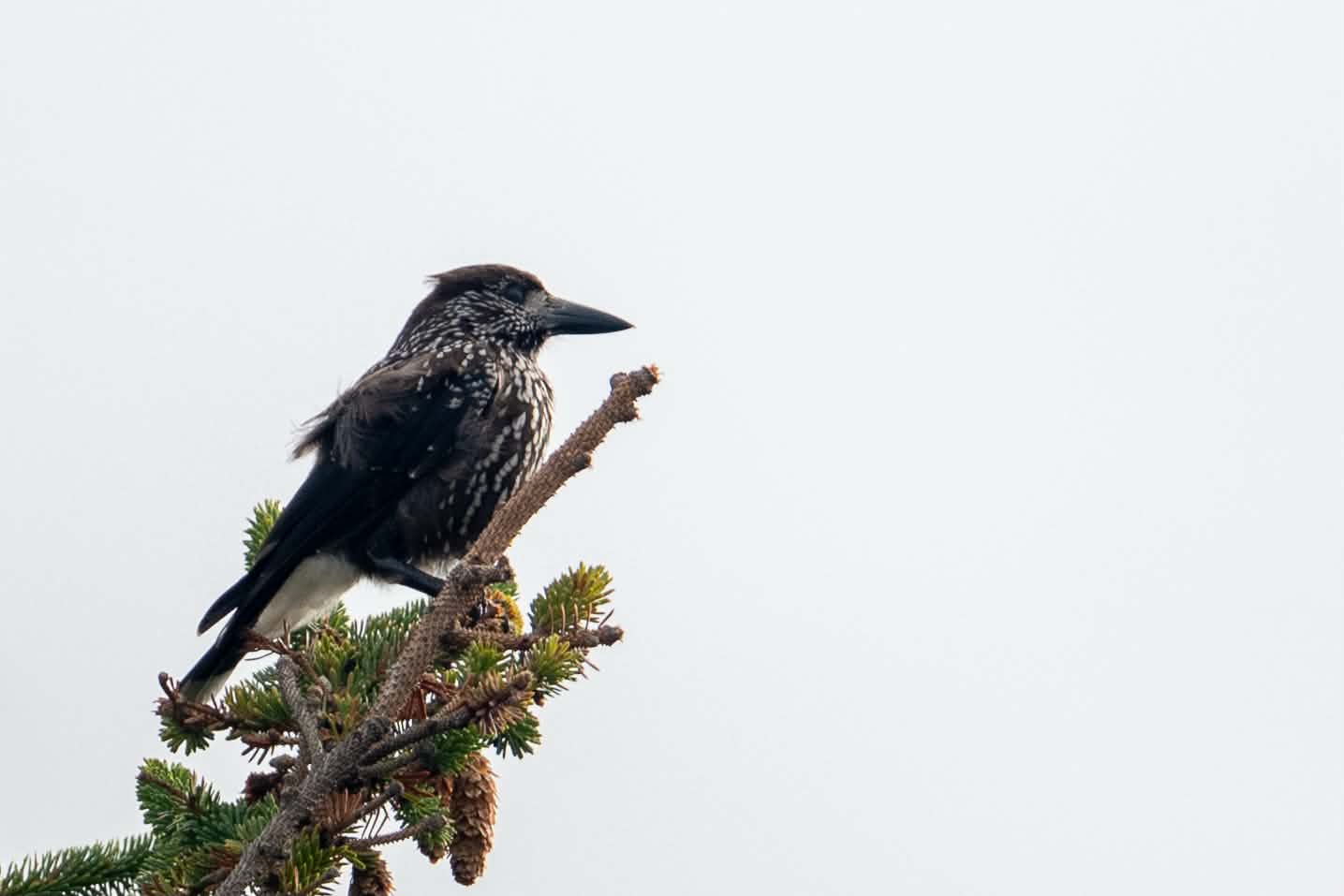 Our very own Northern Nutcracker (Nucifraga caryocatactes caryocatactes ). Captured by Anton Ræbild Jensen
A Yellow-browed warbler (Phylloscopus inornatus) was also heard in the station garden around 2pm. As this being the individual ringed earlier in the day can't be ruled out, it ends as a footnote on todays blog.
Blåvand x Birds = greatest lovestory of all time
At the station: Strummer Edwards, Mathilde Sif Eiby, Anton Ræbild Jensen, Storm Hauris Borum, Johan Them Steffensen, Alex, Bello, Britta
Where are you when you're not here, birds?
mandag 5. oktober 2026
Ringing:
My first blog since returning to ringing, and only because Mathilde took the day off. If you're an avid reader of the blog you have probably noticed that we've enjoyed how much she enjoys writing the blog posts :)
Today was an incredibly slow day. We (Strummer and Johan) ringed 9 new birds and handled one recaptured Eurasian Blackbird (Turdus merula) from this August. The suspects were the usual ones; Common Chiffchaffs (Phylloscopus collybita), Eurasian Chaffinches (Fringilla coelebs) and European Robins (Erithacus rubecula).
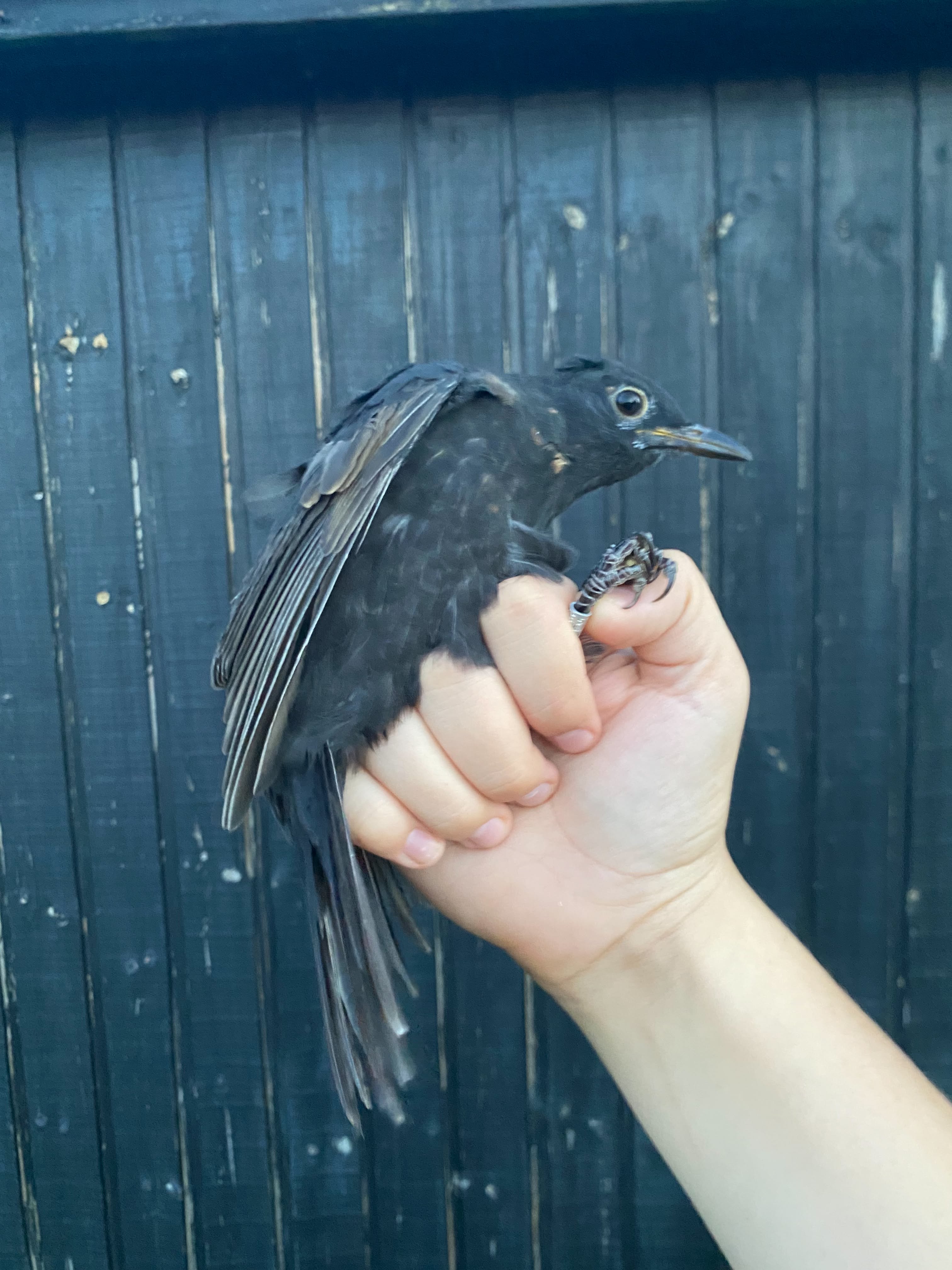 Our recap Eurasian Blackbird (Turdus merula) captured by Johan Them Steffensen
The ringing numbers so you can render your own verdict of the day:
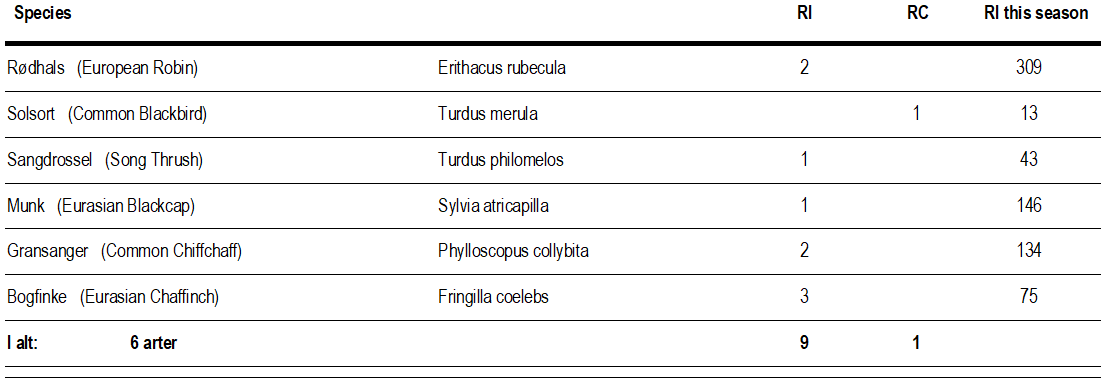
Observation:
Like the ringing, it was a slow morning for the obs with very low numbers of everything apart from gannets (Morus bassanus). It was a letdown for Anton, who is usually the one counting passerines when we're out, but a good day for me, who has been on scoter (Melanitta nigra), diver (Gavia stellata) and gannet counting duty. Although I only have three species to focus on at least I always have something to count!
We ended with 338 gannets today, a very solid count. We try to count them by age when possible, which is is often quite easy as soon as you get the hang of it. In simple terms, the 2-year olds are very dark all over, the 3-years are halfway in moulting their black feathers, the 4-years often just have a black bar at the back of the wing or are in the middle of moulting them, leaving what looks like black piano keys. It's on days like these where you can get some practice with the gannets given the lack of everything else.
At the station: Strummer Edwards, Mathilde Sif Eiby, Anton Ræbild Jensen, Storm Hauris Borum and Johan Them Steffensen
Night catch and more Pipits!
søndag 4. oktober 2026
Ringing: Before telling you about today's standardized ringing, we got a surprise last night! Strummer was doing a bit of night catching, and they caught a Sanderling (Sandløber)! What a lovely, and different textured bird compared to all the passerines - looks more like a plush toy to me, because of those thick dense feathers, and maybe the huge round eye. The proportions are quite interesting as well, with the longer neck and longer bill.
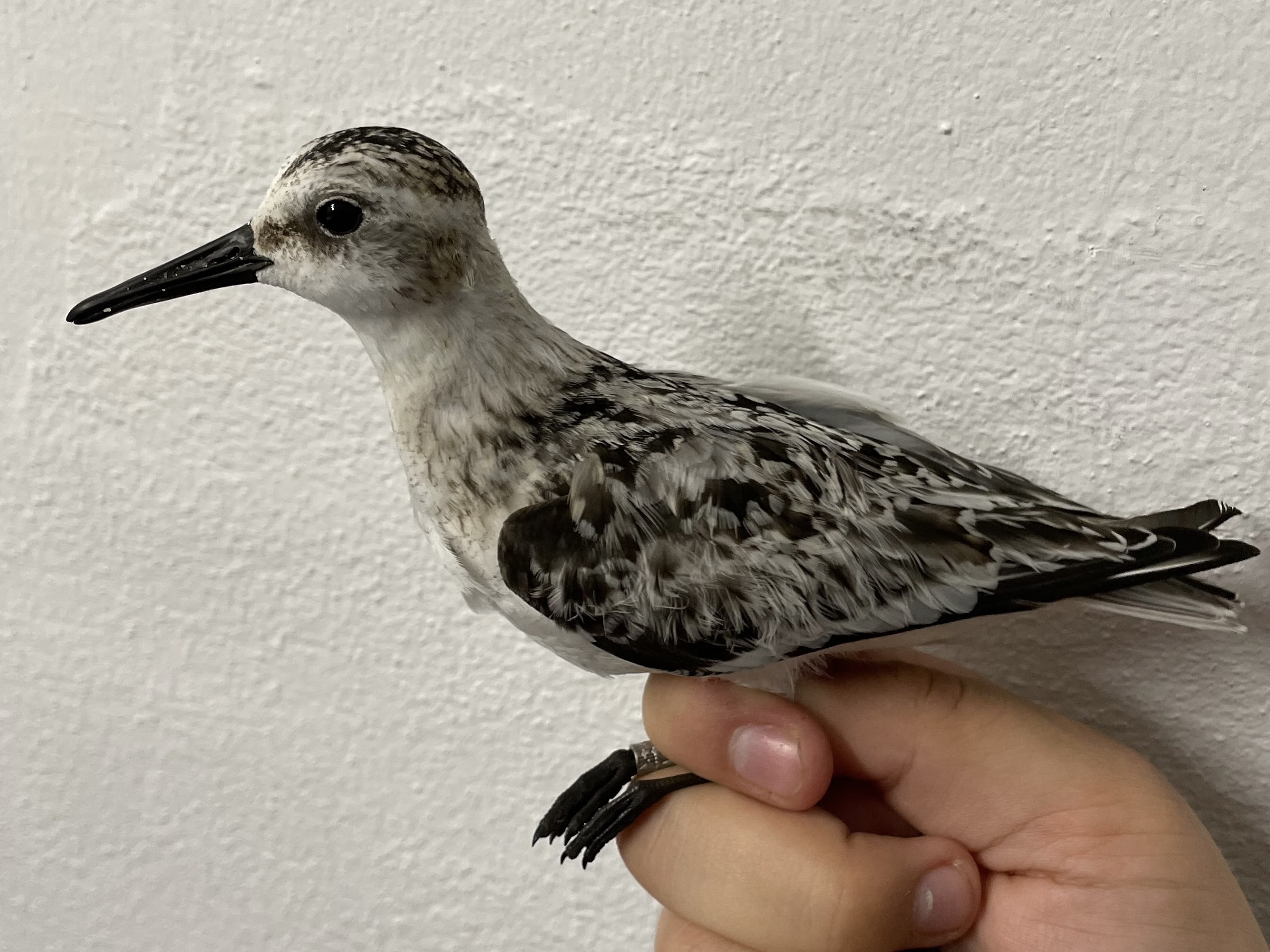
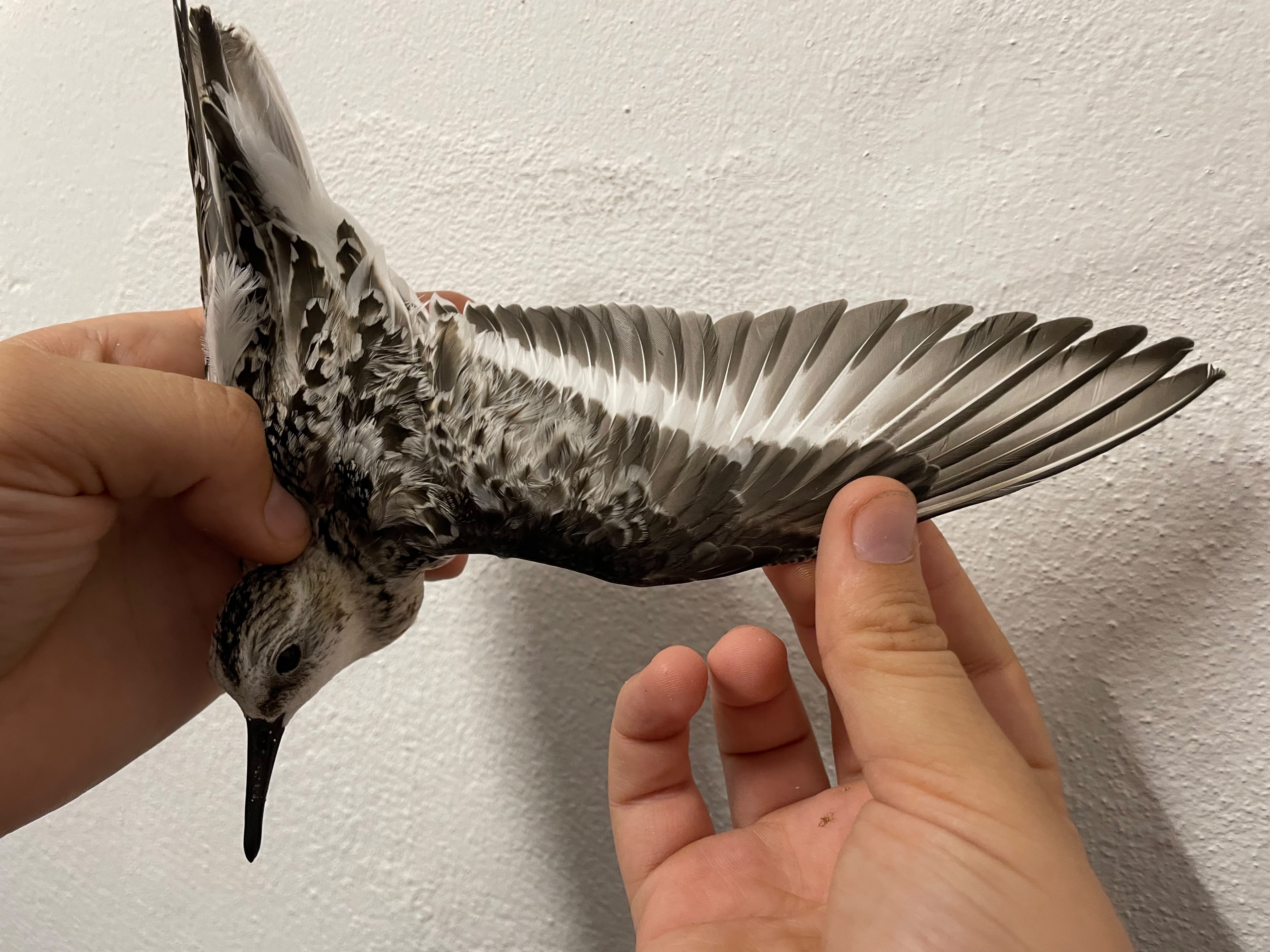 A young Sanderling, aged by the lack of all-black tertial feathers. Pictures by Johan Them Steffensen.
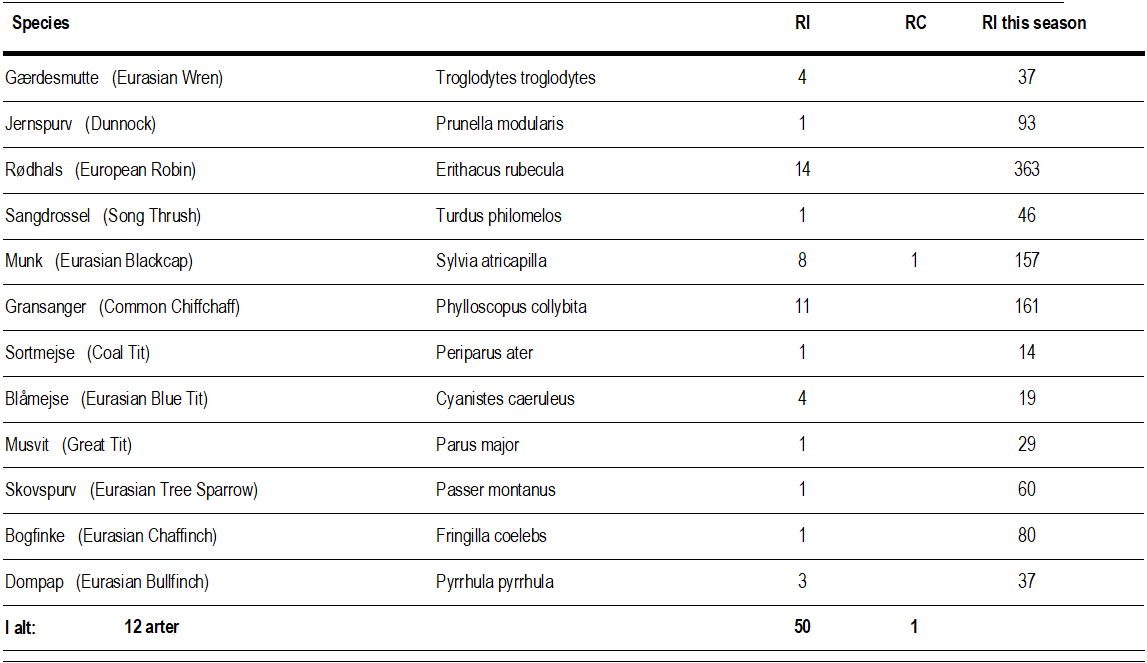
In today's normal ringing we had decent numbers as well with 51 birds of 12 different species in the nets. Most prominent of the day were as usual the 14 Robins (Rødhals), the 11 Chiffchaffs (Gransanger) and the 9 Blackcaps (Munk) - funnily enough all 9 in the station garden. My favourite species of the day was the Blue Tit (Blåmejse), of which I had two young birds in the same net.
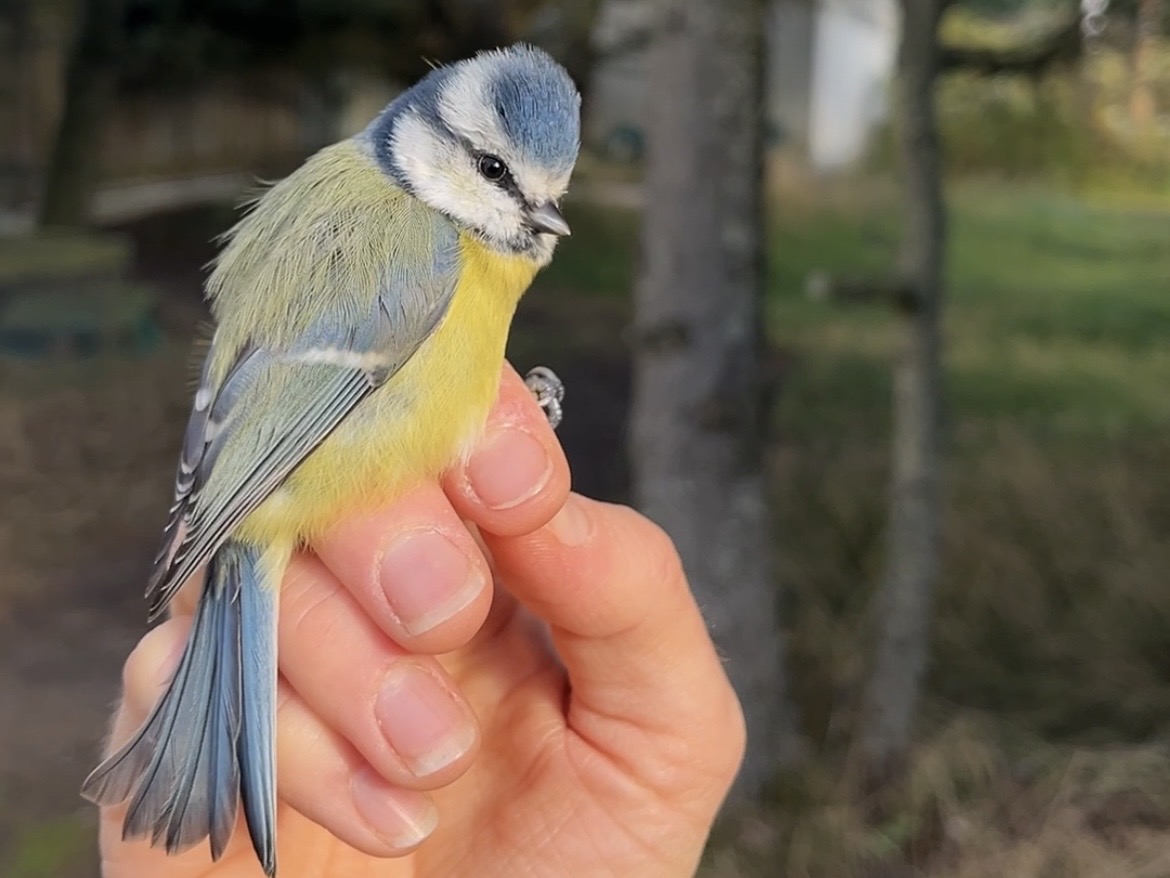 Look at those colours! A beautiful young Blue Tit, aged on the duller feathers in the wing feather group called greater coverts - right there on its shoulder. Picture by Mathilde Sif Eiby.
Today's numbers:
Observation: Today was a much slower day than yesterday. The weather was nice, but the weak wind from the west-northwest gave lower numbers of birds migrating through. The most dominant species were the pipits, with over 240 Meadow Pipits (Anthus pratensis) flying past, and the loons, with over 320 Red-throated Loons (Gavia Stellata) flying south. Good numbers of Starlings (Sturnus vulgaris) and Cormorants (Phalacrocorax carbo) were also seen, but otherwise most of the numbers were quite low.
Just as the obs of today were shaping up to be a bit boring, Henrik suddenly shouted, “Listen, Richards Pipit!” as a pretty sizeable and heavy Pipit flew close by us. The Pipit gave off clear and loud vocalisations that sounded nothing like what you would expect of a Pipit - the sounds were almost sparrow- or lark-like.
Richards Pipit (Anthus richardi) was yet another species I (Anton) have never seen before, and it is the sixth species of Pipit we have seen at obs in just the last seven days! Now we only need Blyth's Pipit (Anthus godlewskii), Water Pipit (Anthus spinoletta), and Tawny Pipit (Anthus campestris) to have seen all the Danish species of Pipits at obs this season
No branch is safe in Blåvand
lørdag 3. oktober 2026
Ringing:
Let’s get back to another slow day at ringing in Blåvand! Myself, Strummer and Storm manned the ringing team and apparently that was more than enough. We kept spirits high but only got visited by 19 newly ringed birds and 3 recaptures. In this stack we had some cool specimens that included a Eurasian Blackbird (Turdus merula), that seemed to have skipped a greater covert in its moult. A very easy limit to see. Other than that we had a decent amount of thrushes in the opening rounds today, and to top it off a male Eurasian Bullfinch (Pyrrhula pyrrhula) that gave some great runway looks. Always a great bird.
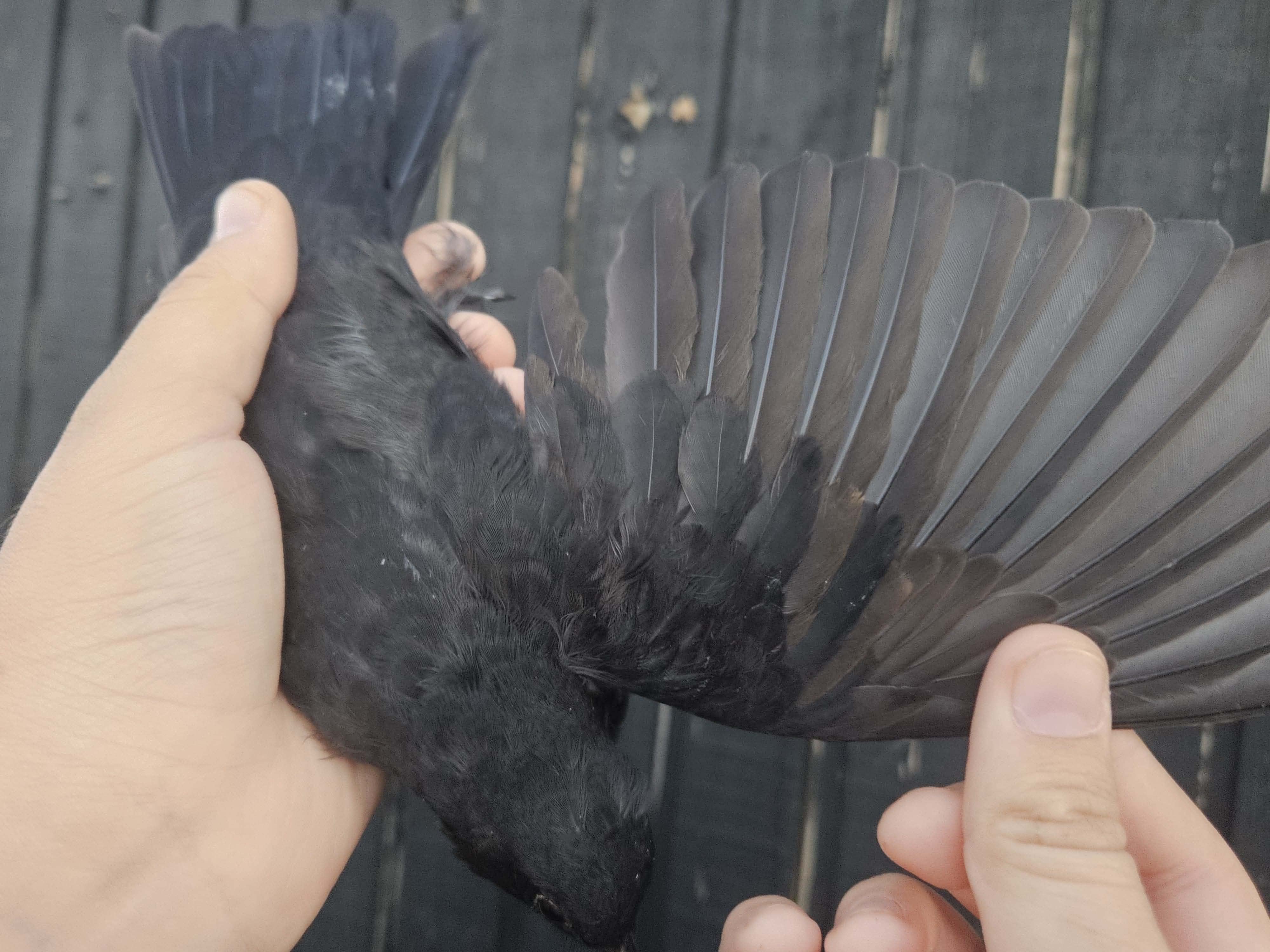
The moult limit can be seen even by the most untrained eye. Weird bird. Photo: Johan Them Steffensen.
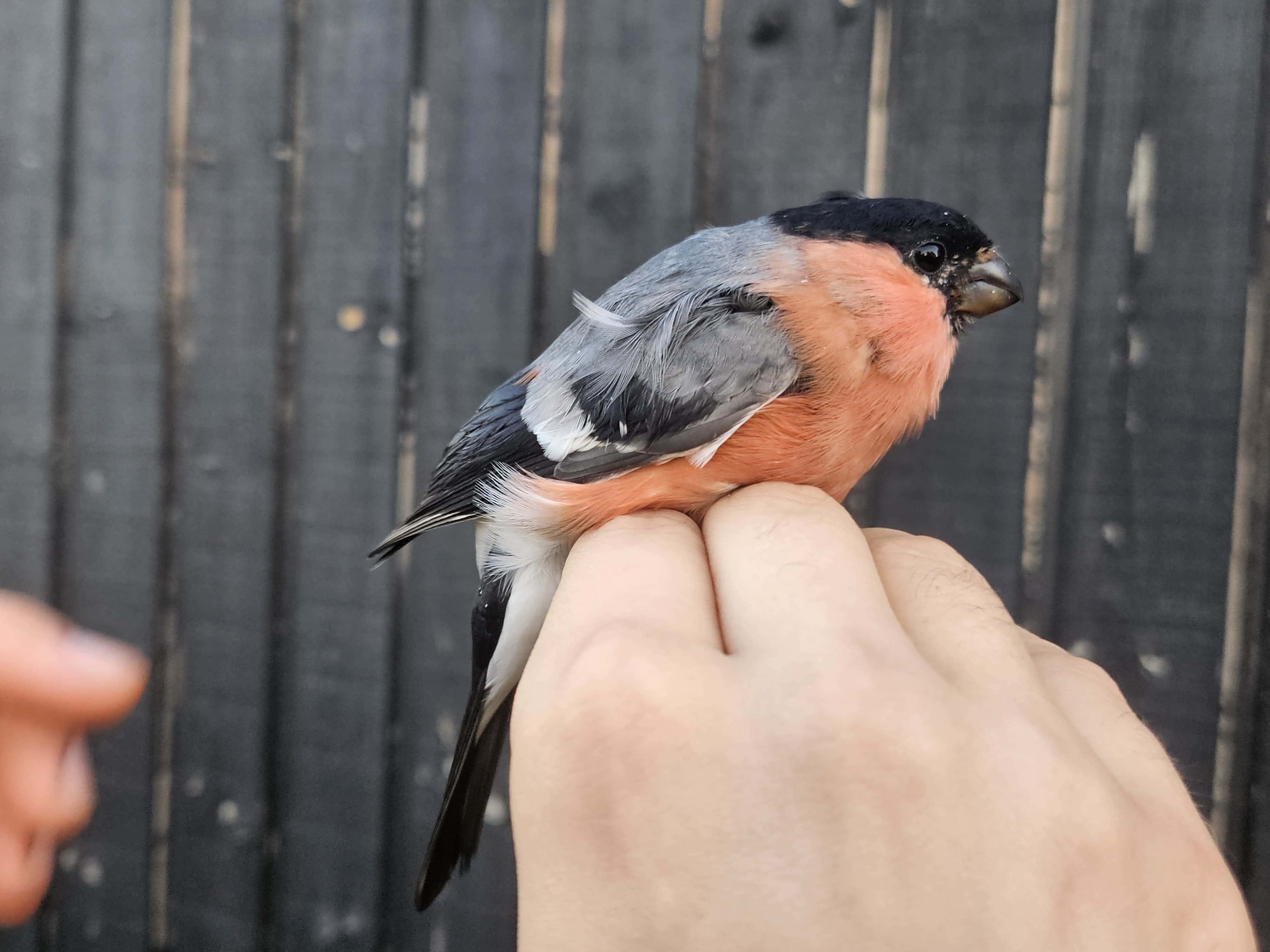
Beautiful Eurasian Bullfinch (Pyrrhula pyrrhula) that needs no introduction. Photo: Johan Them Steffensen.
Observation:
Yesterday was a bit slow, especially after the doozy of an obs we had the day before yesterday (01-10/2026). Today we were lucky enough to be blessed with better winds from the south (i.e. no more of the dreadful wind from the northwest), and it rewarded us with a pretty fruitful day at obs.
Firstly, the numbers were pretty decent. With over 4500 Chaffinches/Brambling (Fringilla coelebs/F. montifringilla) moving through, and other highlights like over 50 Songthrushes (Turdus philomelos) and over 320 Starlings (Sturnus vulgaris) flying past, it was a more than satisfactory day.
Secondly, the rarities were also present. Notably, the Pallid Harrier (Circus macrourus) from yesterday and the day before was still in the area, and it gave yet another great showing. An Olive-Backed Pipit (Anthus hodgsoni) also flew by early into the obs, but unfortunately, no one from the station heard it. A Little Bunting (Emberiza pusilla) passed close by obs around 08.40, which I (Anton Ræbild Jensen) luckily heard, as I have never seen the species before (shoutout to Mikkel Bello for getting it on tape).
Extracurricular activities:
In the comings and goings of the station in news we have had the pleasure of being visited by Kulten from Aarhus University which is student society focusing on field biology. They found some rare birds for us today and we are hoping they’ll do the same tomorrow.
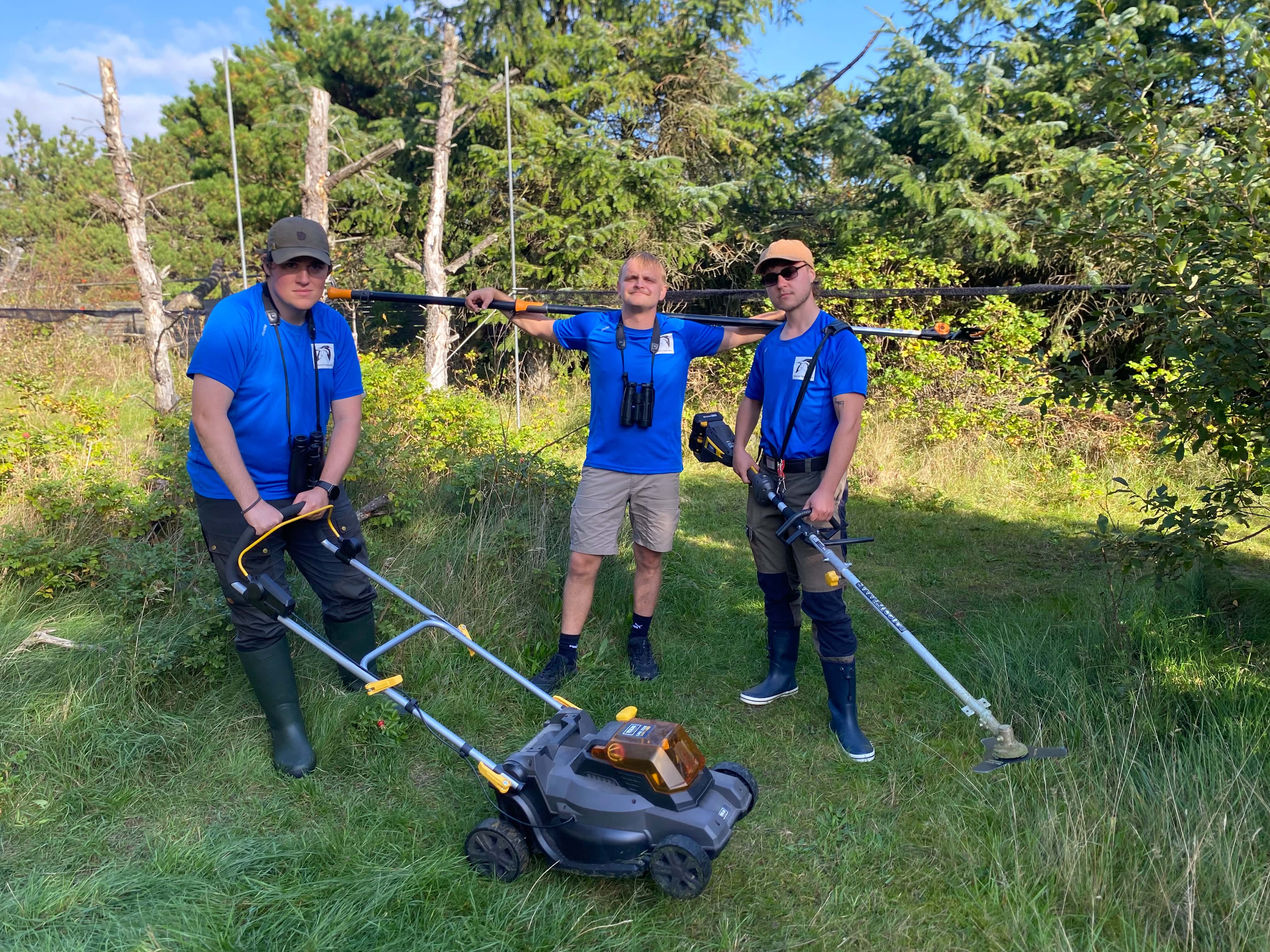
We also utilized the bad ringing winds to gather energy for some garden work. The station bois got to wield some blades and cut stuff. Nice. Who says men can’t prune.
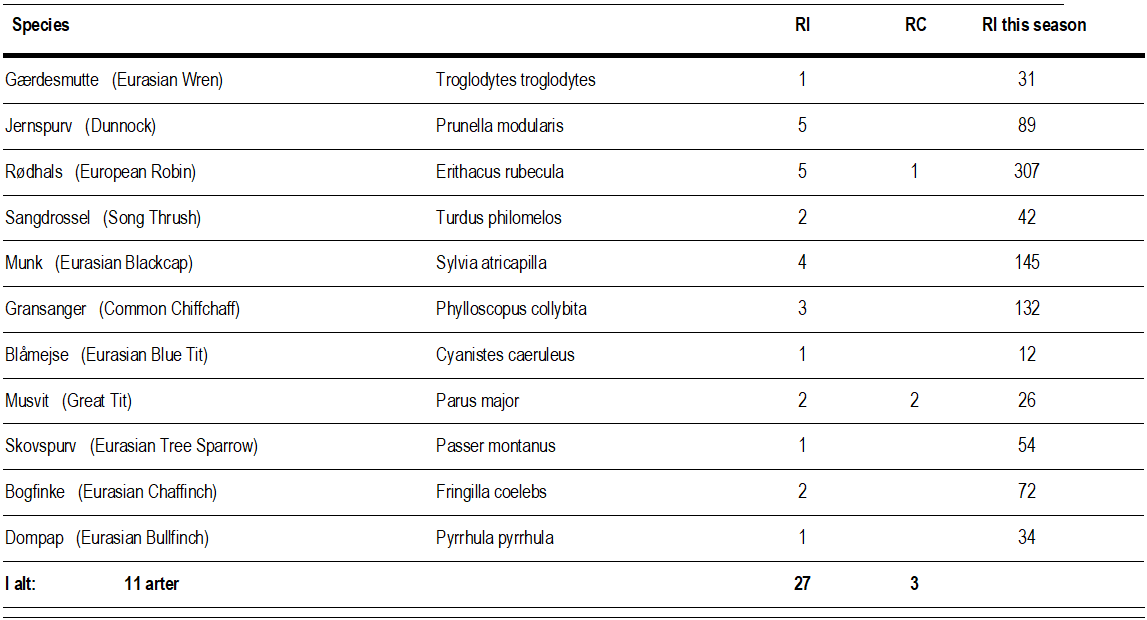
Todays ringing numbers:
At the station: Strummer, Storm, Anton, Mathilde, Johan, Peter, Jonathan, Lærke, Jonas, Anton, Felix, Tue
Just a Bullfinch
fredag 2. oktober 2026
Ringing: Today we reached 30 birds of 11 species. Most notably was this beautiful female Bullfinch (Dompap), that looked adult in the net, but on closer inspection had a clear moult limit in the wings, which means it must have been born this year.
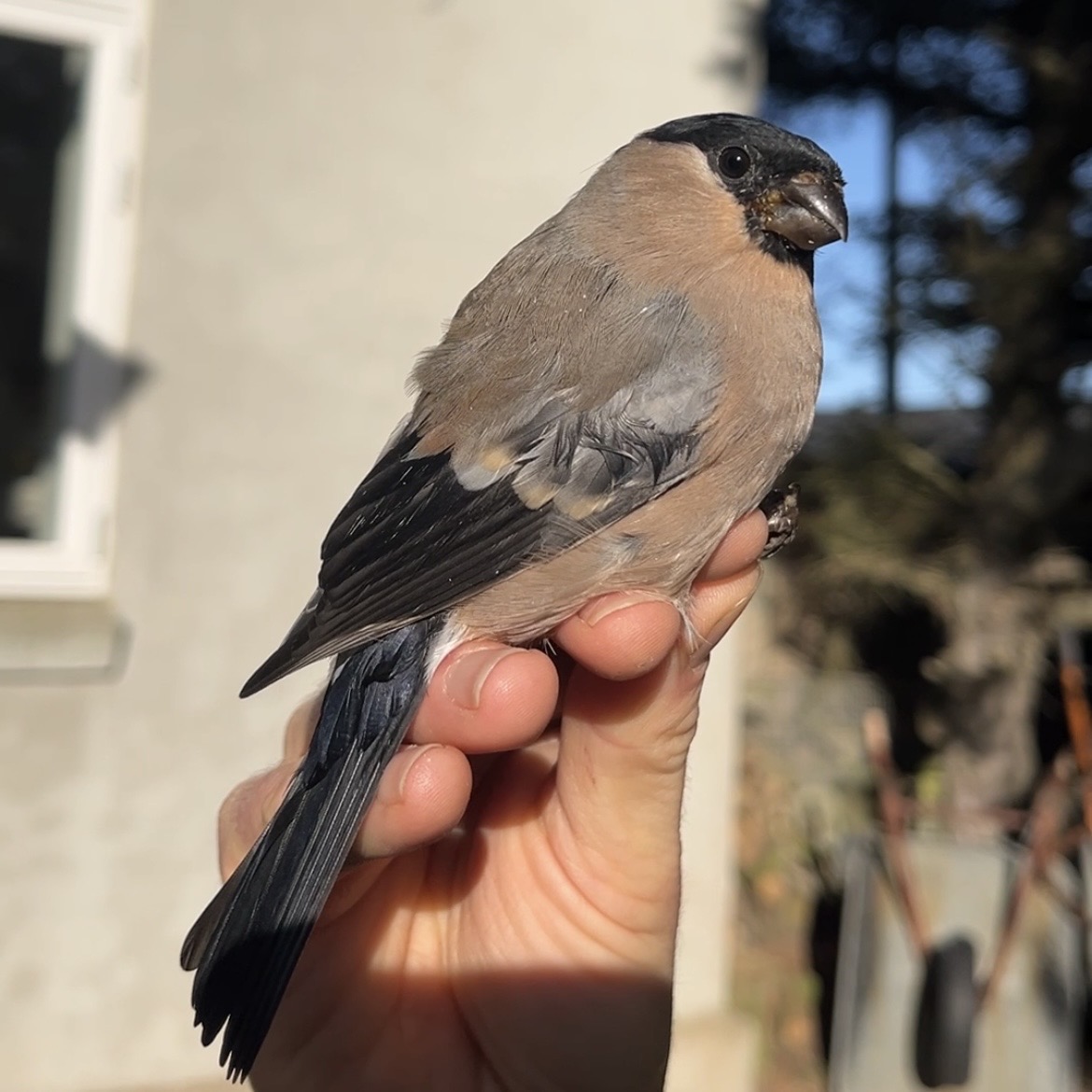 Young female Bullfinch from today, sexed by the grey overall look (the sun distorts the colour here), and aged by the browner feathers in the feather group on the wing called greater coverts. Picture by Mathilde Sif Eiby.
With these slower ringing days, tomorrow I'll join Anton for the observation instead, so I can become better at distinguishing sea birds and bird calls as well.
Today's numbers:
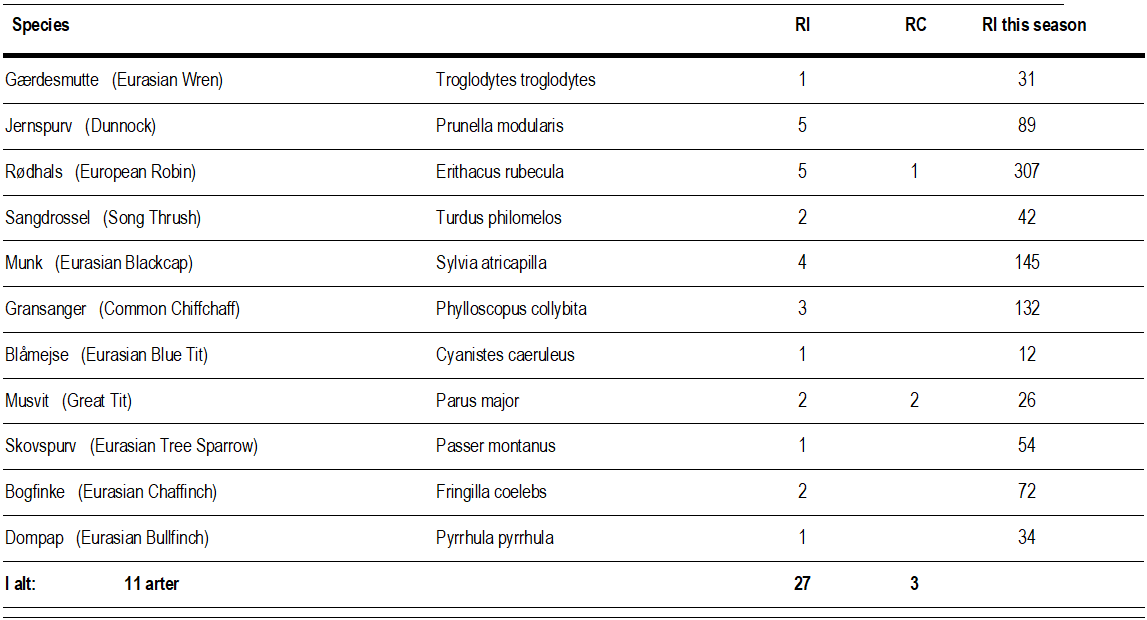
Observation: Although the weather today seemed promising, it was another relatively quiet day on the dunes. Nice numbers of gannets (Morus bassanus) and red-throated divers (Gavia stellata) today, but nothing extraordinary. Common scoter (Melanitta nigra) numbers also quite low, only just making it to 600 individuals. The North-Eastern winds seem to have pushed many migrants inland, including the few flocks of geese we saw, which took the route over the heath behind us rather than over the sea. Today's highlight was a pallid harrier (Circus macrourus), potentially the same individual as spotted yesterday.
This evening, we were joined at the station by a group of young birders from Århus university, who are staying for the weekend and will join us for observation tomorrow, as well as partake in some "kratluskeri" a.k.a. bush creeping for cool birds in the Blåvand area.
At the station: Strummer Edwards, Mathilde Sif Eiby, Anton Ræbild Jensen, Storm Hauris Borum and Johan Them Steffensen
Quantity and Quality for Some
torsdag 1. oktober 2026
Ringing: Today I was joined by Storm in the lab, since Johan was sick. We had an okay varition of birds, including some new ringing species for Storm, and a new species in the net for the season - the Black Redstart (Husrødstjert).
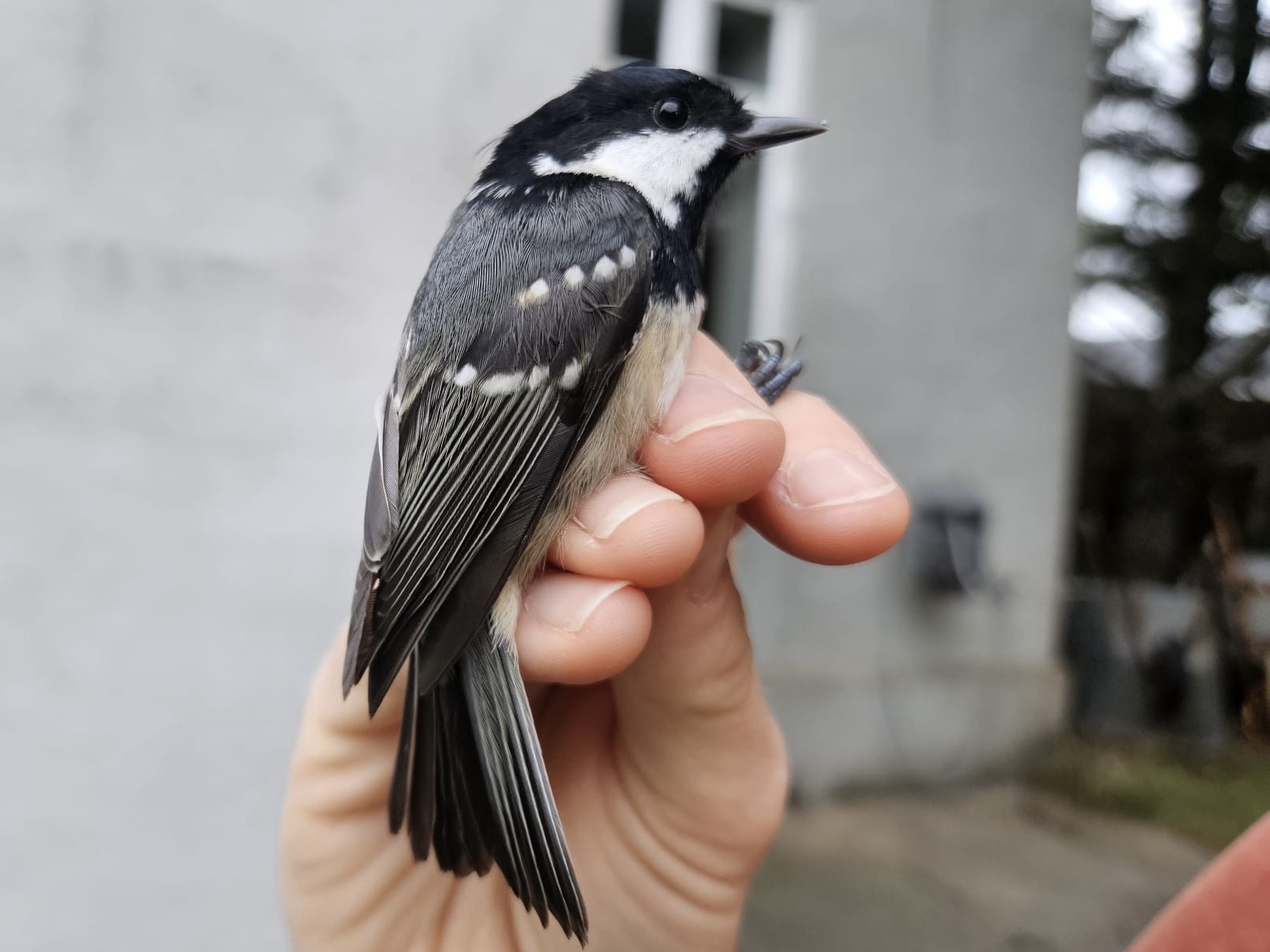 Coal Tit (Sortmejse) from today. Picture by Storm Hauris Borum.
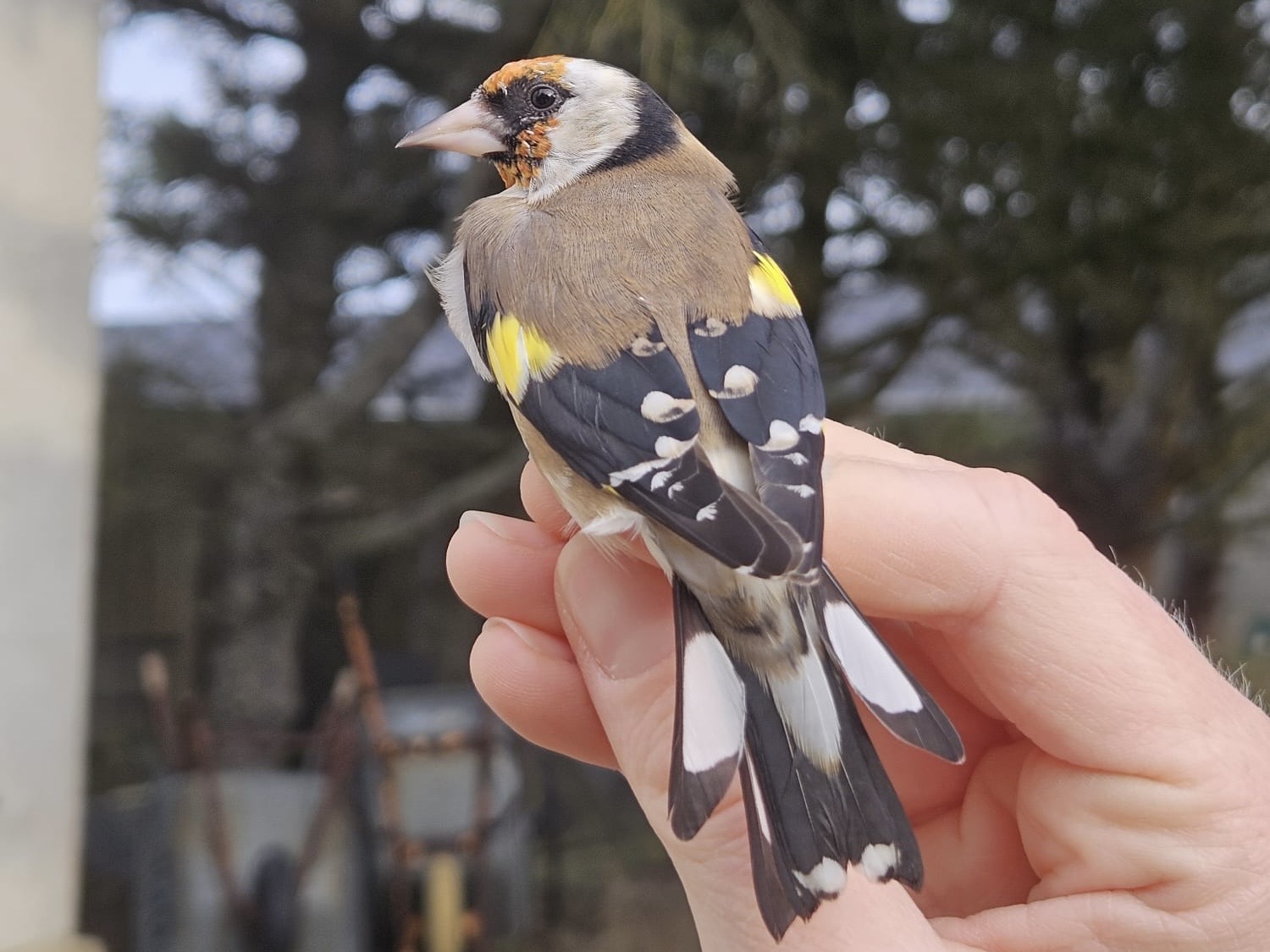 Goldfinch (Stilits) from today. Picture by Storm Hauris Borum.
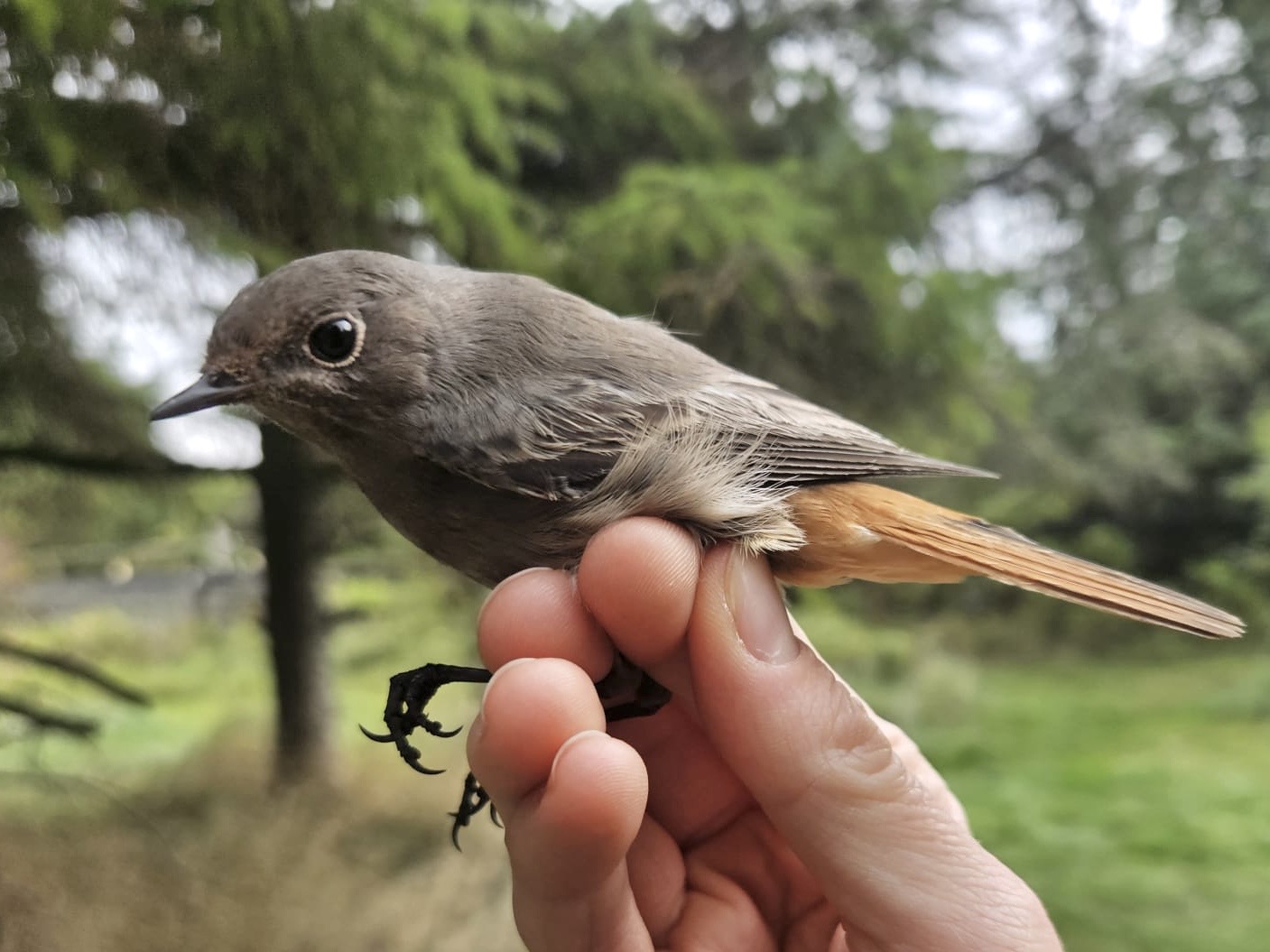 First Black Redstart of the season! Picture by Storm Hauris Borum
Today's numbers:
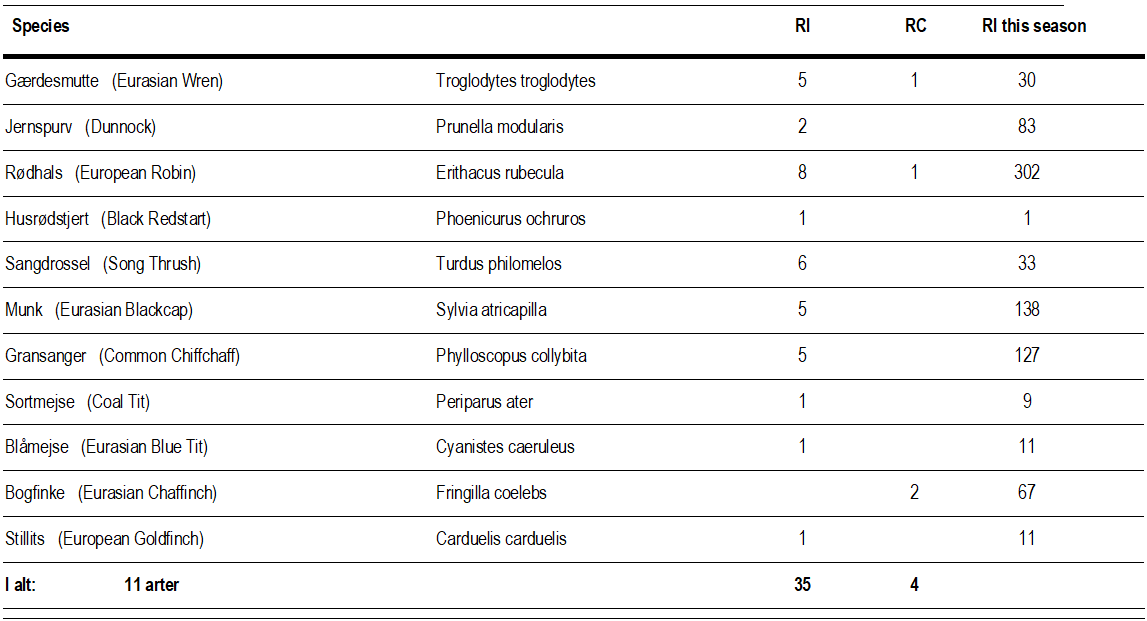
Observation: Holy s**t, today was (unexpectedly) amazing!
The wind has been pretty much the same the last couple of days, that being eastern and south-eastern winds. Now, eastern winds are, of course, nothing to complain about at Blåvand, as already clearly demonstrated by the huge number of passerines moving through lately. The thing is that changes in wind direction are just more exciting than constant wind from one direction, and I honestly expected that today would be decent, if slightly worse than yesterday… man, was I wrong!
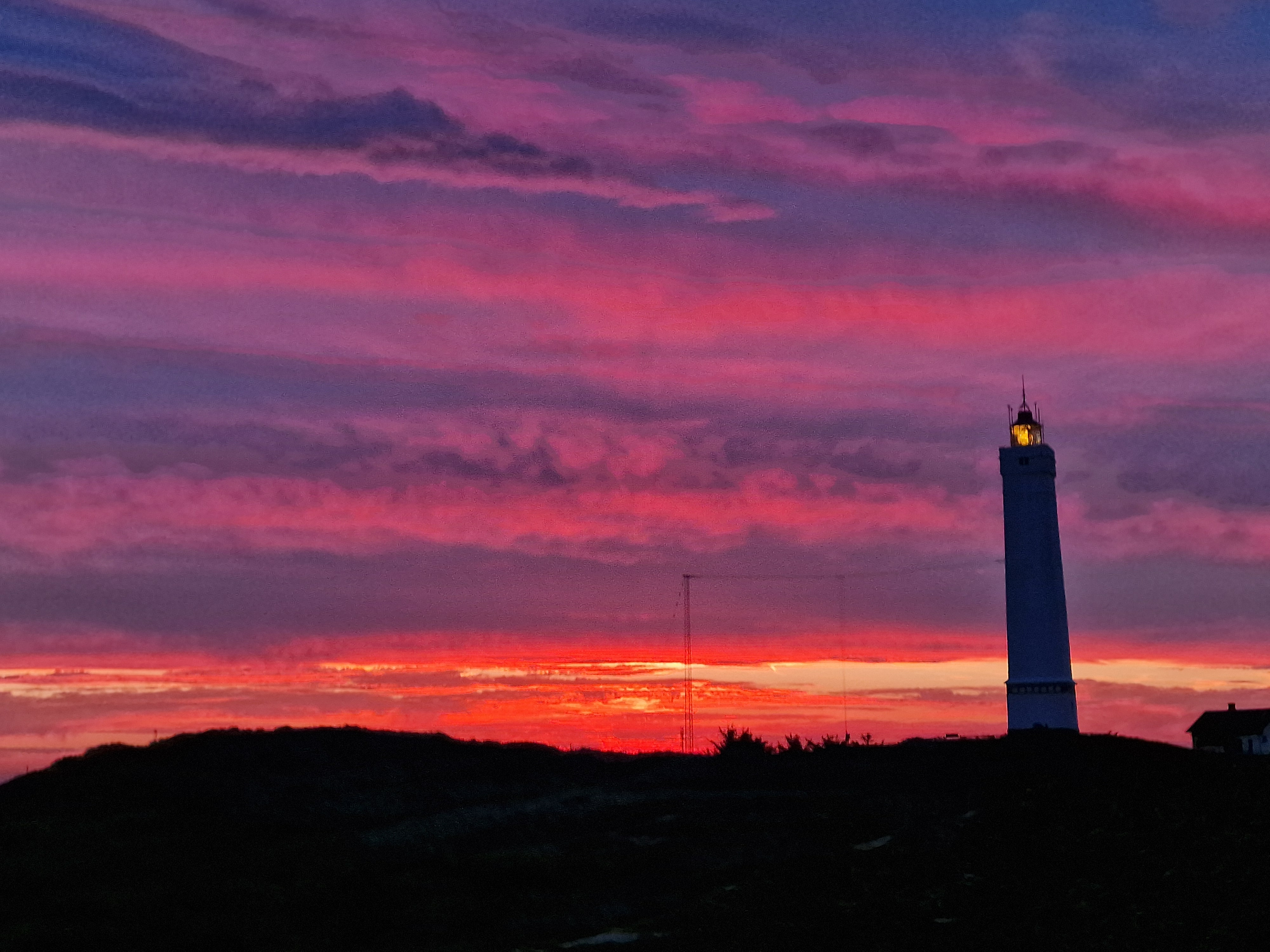
The sunrise that met me at obs today. Credit Anton Ræbild Jensen.
Today at obs, it was just Henrik and I from the station, but I wasn’t worried, as whenever Henrik is at obs, we always document way more species. The day started at 7.15 with a beautiful sunrise and a couple of Common Scoters (Melanitta nigra) and Meadow Pipits (Anthus pratensis) moving as usual. However, at 07.32, a weird Tree Pipit-like (Anthus trivialis) bird flew past me, and Henrik asked me if I heard it. Apparently, it was an Olive-backed Pipit (Anthus hodgsoni), one of my bucket-list species for Blåvand, and I was already ecstatic about today's obs! What I didn’t know at that point was that we were just getting started, as just 40 minutes later another Olive-backed Pipit went right by, this time letting me hear it very clearly before disappearing south.
And as if those two rarities weren’t enough, we also managed a Lapland Longspur (Calcarius lapponicus), two Pallid Harriers (Circus macrourus), and a Red-throated Pipit (Anthus cervinus). The Harriers gave us amazing views, and the Red-throated Pipit was especially amazing. It appeared right at eye level with a couple of Meadow Pipits and gave off two extremely clear and characteristic “PSEUI” calls so loud and sharp that they almost hurt our ears. The Red-throated Pipit is generally a difficult species to find, and this is the first in almost two years to be seen at the Huk.
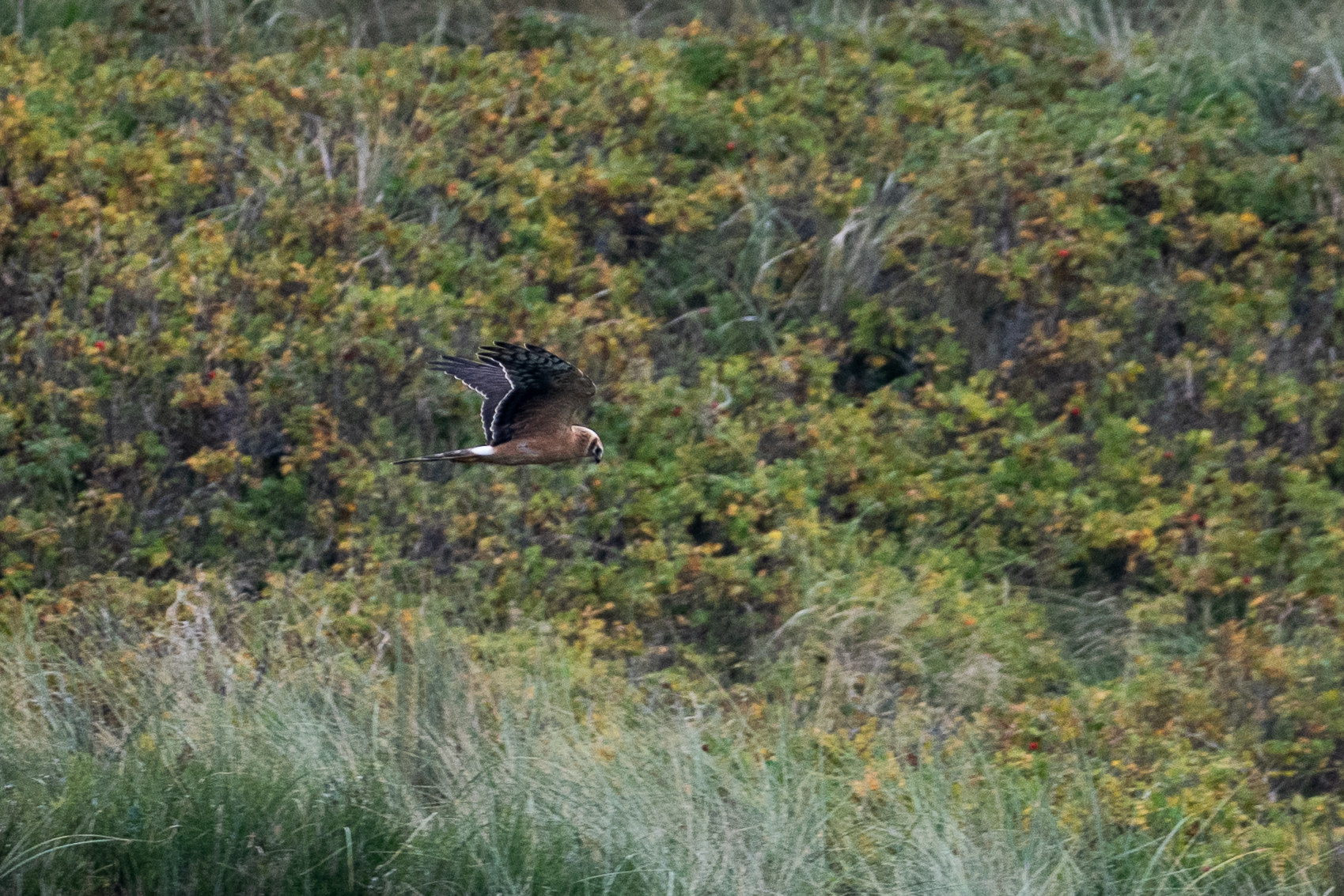
One of the Pallid Harriers giving us excellent views on fly-by. Credit Anton Ræbild Jensen.
By this point, you, the reader, might be convinced that today was all about rarities. Usually, obs is either a game of quality or quantity (sometimes neither), but today has proved that you can, apparently, have your cake and also eat it. What I mean, in short, is that while we had a sizeable amount of really good rarities today, we somehow also managed to get amazing numbers of migrating birds. The highlights include: 2380 Common Scoters, almost 7000 Chaffinces/Bramblings (Fringilla coelebs/F. montifringilla), 104 Common Snipes (Gallinago gallinago), 184 Red-throated Loons (Gavia stellata), close to 500 Greylag Geese (Anser anser), 450 Starlings (Sturnus vulgaris), and so much more!
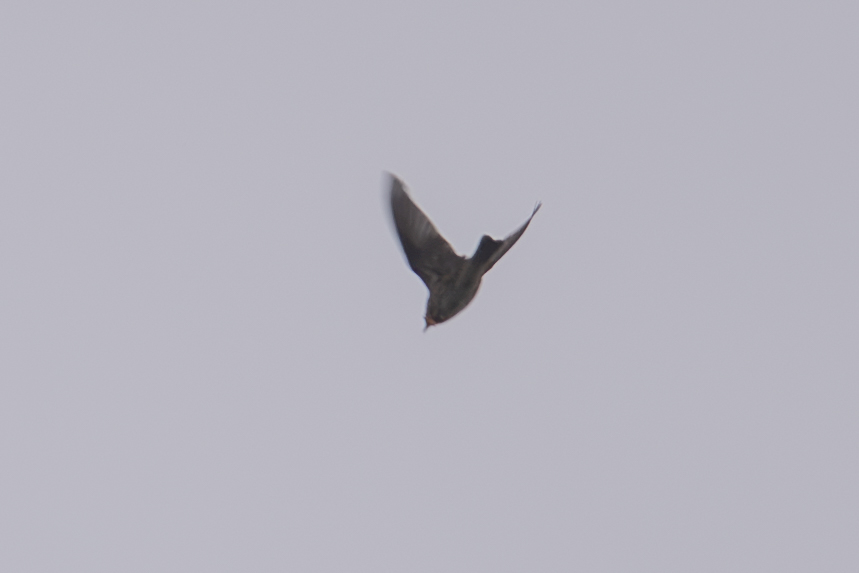
Possibly a docu-shot of one of the Olive-backed Pipits today. Credit Anton Ræbild Jensen.
This might genuinely be one of, if not the best, days of the fall season. I will, however, keep doing my best to top today. Maybe tomorrow might have the same potential as today - we will see…
At the station: Strummer Edwards, Mathilde Sif Eiby, Anton Ræbild Jensen, Storm Hauris Borum and Johan Them Steffensen