
Her på Blåvand's blog bringes korte nyheder i dagbogsformat om livet og hændelser på fuglestationen.
-
FORSIDE

- Blog
Migrants on the move and a two-sunset day
onsdag 12. august 2026
Observations:
The day started with the northwesterlies weakening, giving more favourable conditions for the observation. The wind got almost completely calm in midday, and until sunset. Almost clear skies and soft temperatures gave a really pleasant birding day!
The morning count was interesting, with a Dotterel migrating south being the main highlight.
A nice arrival of passerines made this the best morning for migrant species since we arrived. Common Redstart, both species of Flycatchers, both Whitethroats, Chiffchaff, Willow Warbler, Garden Warbler, Blackcap, Icterine Warbler, Eurasian Reed Warbler, Northern Wheatear, Tree and Meadow Pipits or Yellow Wagtails were some of the migrant species seen in Blåvandshuk area today.
Seeing a group of around 12 Gray Partridge just ~1 km away from the station and a group of 10 Snipes flying south at very low height at the same spot was a remarkable moment.
The evening was perhaps quieter, but still some movement of waders made possible to increase the daily total numbers. Some groups of Oystercatchers, Calidris spp., and Turnstones - with 40 birds, the highest number of the season for them so far. The partial solar eclipse was a special moment during the migration count!
Ringing:
It has finally happened. For weeks, we have been eagerly anticipating its arrival: We finally had a decent day of standardized ringing!!!
After a few days of inconsistent weather but consistently low numbers of birds, the sudden mild weather and winds of today turned out to be just what the migrants were waiting for to turn that trend around. Already by the first two rounds, we were catching a bit more than what we have previously done at those times of day, but it was at the third round of standardized ringing that the numbers really took off.
Starting off at the Station garden, the first couple of nets had already produced a few catches, signalling that this might become a slightly busy round, and when we got to the first 18 m net on our route, Johan began working on extracting the first bird in that net, while I went over to the second, hanging a little distance from the first. As I approached, I could see that it was a pretty big bird, closer to the size of a thrush than a common warbler, and when I got to it, it was not a thrush sitting in the net, but instead a beautiful young Red-backed Shrike (Lanius collurio)!!! The very first of the season. As we had about 6 other birds this round just from the Station garden, we started off with ringing and processing these, giving Lois, who was interested in seeing the Shrike, time to get here.
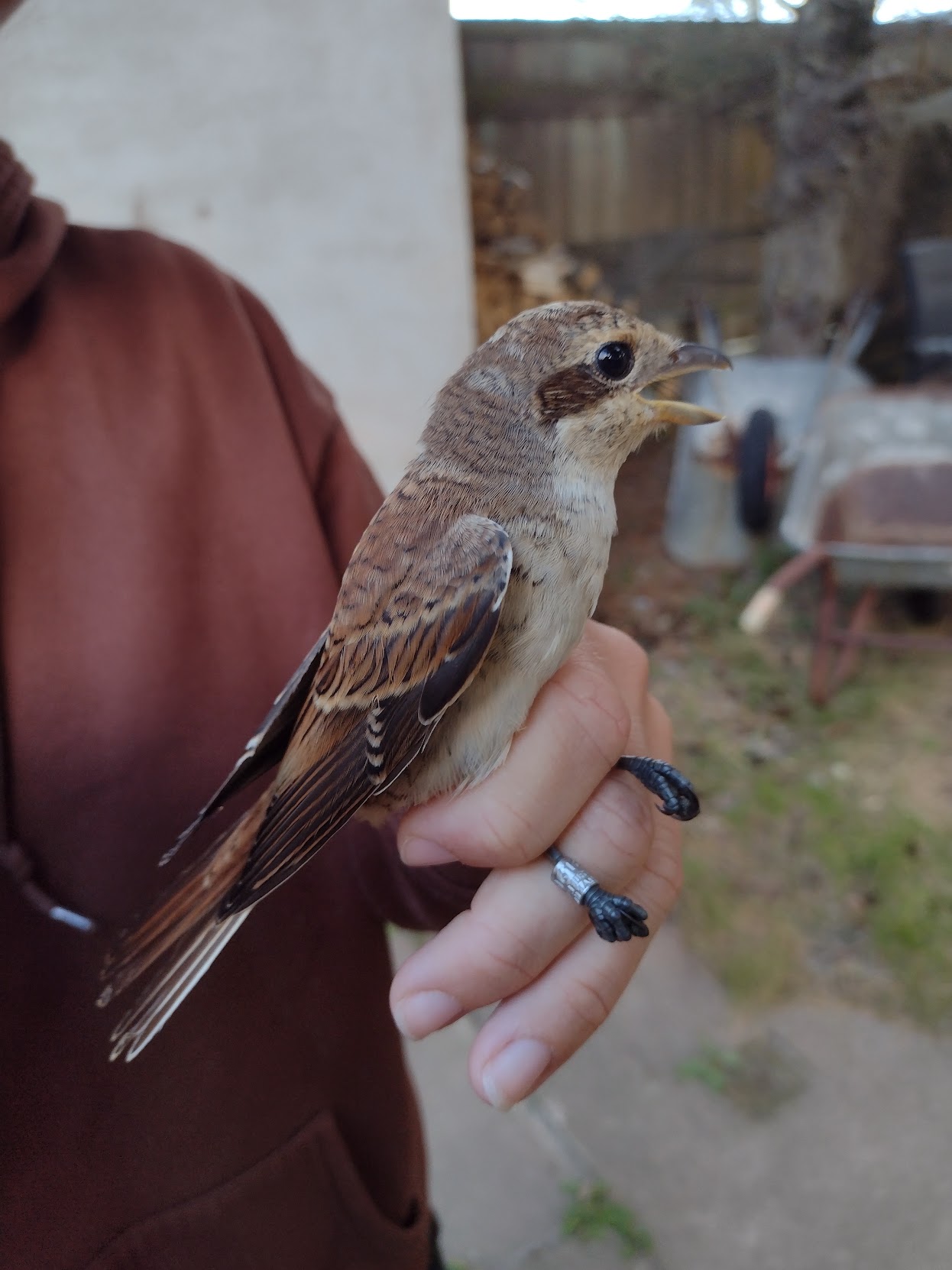
The young Red-backed Shrike. Shrikes are well-known for their ferocious bites, however this one was not able to pierce our flesh. Foto: Alba M. Holmberg
After releasing the Shrike, I was pretty fired up, anticipating pretty good numbers for the rest of the day. And even though the peak was over, we still did not have even a signle round with no birds, with many of the birds we did catch being migrants, such as fat Garden Warblers (Sylvia borin), Common Redstarts (Phoenicurus phoenicurus) and a few more Pied Flycatchers (Ficedula hypoleuca). After standard, we closed the nets at the lighthouse but kept the Station garden open, and we even set up a new net out on the parking lot in hopes of catching some of the House Martins (Delichon urbicum) that nest under the roof of the Bird Station. Although most of the Martins easily dodged the net, two young House Martins and a single young Tree Sparrow (Passer montanus) did manage to fly into it, and were consequently ringed.
We ended up closing the nets no sooner than at 20:01, and by the end of the day, we had managed to catch (not counting night-catching) 46 birds of which 33 were newly ringed and 13 were recaptures.
Today's captures:
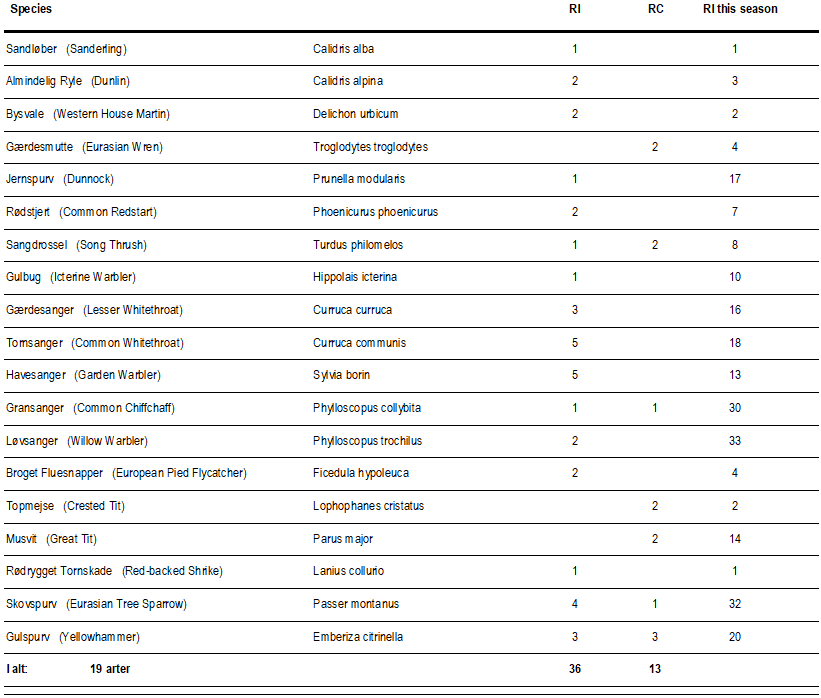
After sunset, we also tried to catch Eurasian Nightjar using the newly erected swallow-net, though without luck. Strummer (who returned ealier in the day) did however see one fly over the Station. Although the night from 12/8 to 13/8 bore no success, that was not the case for the night from 11/8 to 12/8, which is where the Sanderling (Calidris alba) and the two Dunlins (Calidris alpina) in the overview are from.
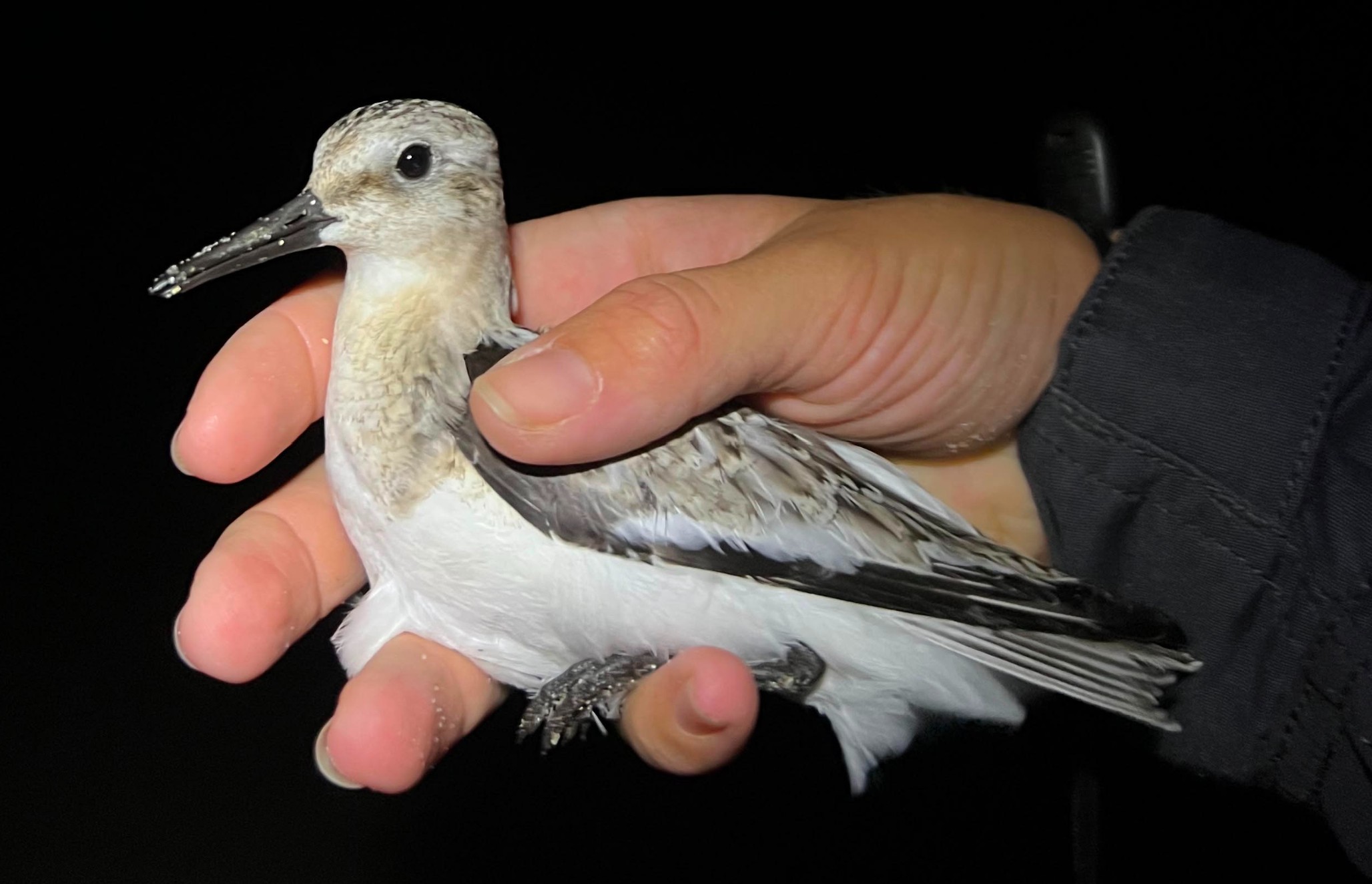
Young Sanderling caught during night-catching. Foto: Ida Bek
At the station: David, Miguel, Nico, Lois, Alba, Johan, Ida, Strummer, Jonas